
Competition among artificial intelligence models has often been framed as a race in parameter count: the larger the model and the greater the compute, the stronger its capabilities.
Qwen3.8-27B points to another path.
It has only about 27.8 billion parameters—far fewer than many closed-source flagship models—and it does not rely on a mixture-of-experts architecture to push its total parameter count into the hundreds of billions or even trillions. It is a dense model that activates the entire network during inference. Yet according to Qwen’s official results, it has matched or surpassed Opus 4.6 Max in the comparison table on selected software engineering, long-horizon office work, instruction-following, and computer-use benchmarks.[web:65]
The point worth remembering is not the oversimplified slogan that “a small model has defeated a large model.” It is this:
When a 27B model begins to perform work at the level of a closed-source flagship, parameter count is no longer the most reliable measure of a model’s capability boundary.
What Can 27B Actually Do?
Qwen3.8-27B stands out less for general knowledge questions than for its agentic and software engineering capabilities.
Compared with Qwen3.6-27B, its Terminal-Bench 2.1 score rises from 63.4 to 73.0, an increase of 9.6 points. SWE-bench Pro improves from 53.5 to 61.7, while NL2Repo moves from 36.2 to 42.3. DeepSWE 1.1 climbs from 13.3 to 42.2—3.17 times its predecessor’s score. On Qwen’s own QwenSWEBench, the score rises by 29.7 points, from 49.3 to 79.0.[web:65]
What these benchmarks have in common is that they ask a model to handle something more complete than “answering a coding question.” The model may need to inspect an existing repository, understand relationships between files, operate a terminal, modify code, run tests, interpret error messages, and revise its approach. The question is no longer whether a model can produce a plausible-looking code fragment, but whether it can actually complete the work.
The improvement in agentic capability is equally visible:
CoWorkBench, which measures long-horizon office work, rises from 61.0 to 70.7—an increase of 9.7 points.
JobBench, which covers professional tasks, rises from 21.8 to 33.4—an improvement of roughly 53%.
On Agents’ Last Exam, Pass@1 nearly doubles from 10.6 to 20.4, while the overall score rises from 27.3 to 42.9.[web:65]
This suggests that Qwen3.8-27B is not merely getting better at answering questions. It is becoming better at sustaining a task: planning the next step, using tools, reading environmental feedback, detecting errors, and continuing until the work is complete.
Does It Really Beat Closed-Source Flagships?
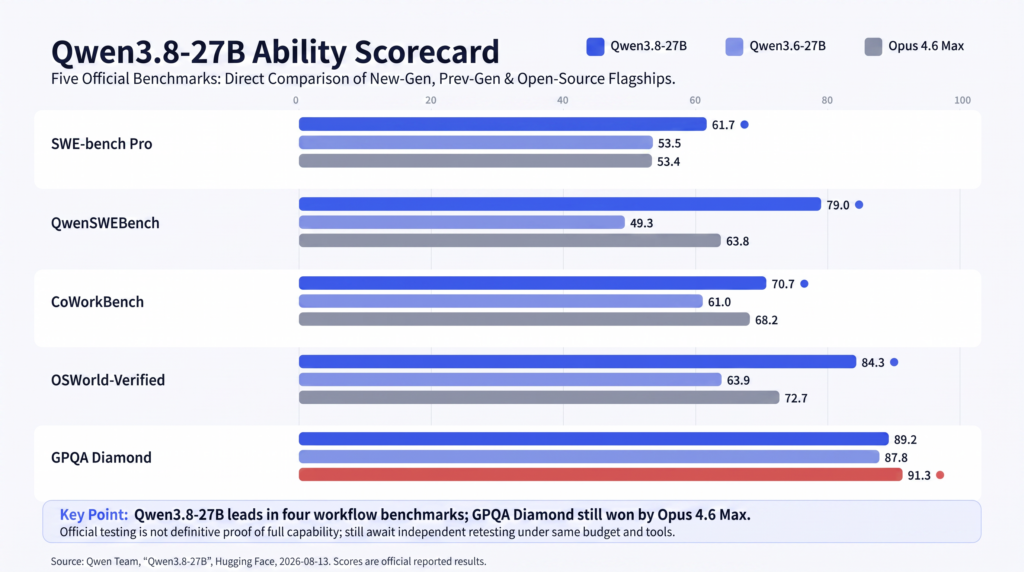
Qwen’s official comparison places Qwen3.8-27B alongside Qwen3.6-27B, Qwen3.7-Plus, Muse Glimmer-30B, and Opus 4.6 Max. The most newsworthy result is that this 27B dense model outperforms Opus 4.6 Max on several reported benchmarks:
| Benchmark | Qwen3.8-27B | Opus 4.6 Max | Difference |
|---|---|---|---|
| SWE-bench Pro | 61.7 | 53.4 | Qwen leads by 8.3 points |
| QwenSWEBench | 79.0 | 63.8 | Qwen leads by 15.2 points |
| CoWorkBench | 70.7 | 68.2 | Qwen leads by 2.5 points |
| IFBench | 79.5 | 62.5 | Qwen leads by 17.0 points |
| LiveCodeBench v6 | 90.3 | 88.8 | Qwen leads by 1.5 points |
| OSWorld-Verified | 84.3 | 72.7 | Qwen leads by 11.6 points |
| AndroidWorld | 81.9 | 62.0 | Qwen leads by 19.9 points |
| SWE-MM | 38.6 | 27.1 | Qwen leads by 11.5 points |
On computer- and mobile-use benchmarks such as OSWorld-Verified and AndroidWorld, a model must do more than understand instructions. It needs to observe the screen, identify interface elements, execute multistep actions, and respond to changes encountered along the way. Qwen3.8-27B’s performance on these tasks reflects a shift from a model that generates answers to one that can act inside a digital environment.[web:65]
That does not mean it has comprehensively surpassed Opus 4.6 Max.
Qwen3.8-27B scores 73.0 on Terminal-Bench 2.1, below Opus at 78.2. Its NL2Repo score of 42.3 trails 47.6, while its GPQA Diamond result of 89.2 is slightly below 91.3. The gap is larger on HLE, a benchmark for difficult multidisciplinary reasoning: Qwen scores 30.8, compared with Opus at 40.0.[web:65]
A more accurate conclusion is that Qwen3.8-27B is not the strongest model across the board. However, it has entered closed-source flagship territory on several benchmarks closely related to practical work—including agents, programming, and computer use—and leads on some of them.
These figures also require context. Most come from Qwen’s official evaluation. Some benchmarks were created by Qwen, and certain evaluations use other models as judges. The compared models may not have been tested with identical tool frameworks, reasoning budgets, or configurations. The results are strong evidence of the model’s direction of travel, but they should not be presented as independently verified proof that it “beats every closed-source model.”[web:65][web:101]
Four Generations: The Model Did Not Grow, but Its Work Horizon Did
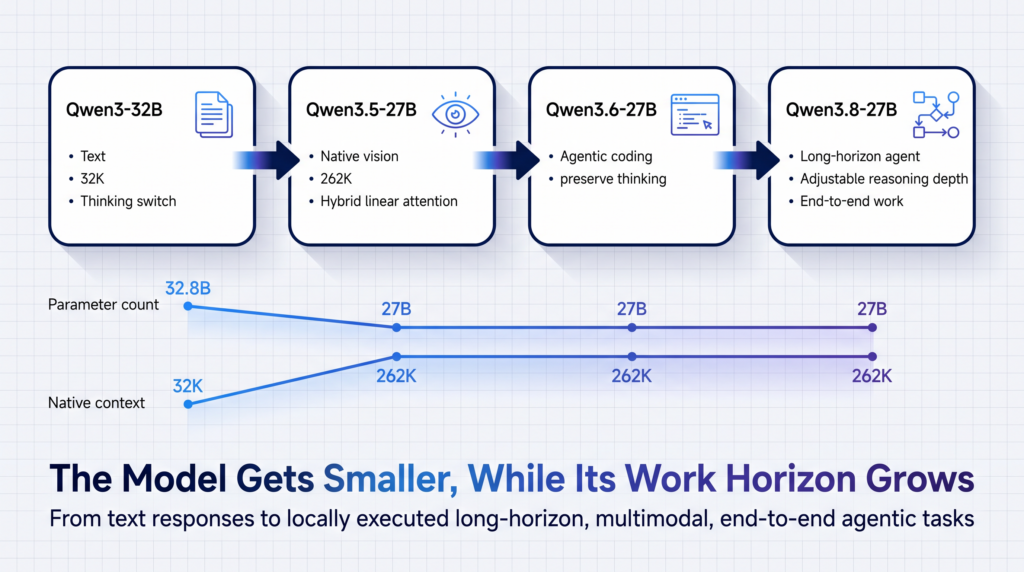
To understand why Qwen3.8-27B matters, it helps to trace the dense-model line back to Qwen3-32B.
Qwen3-32B: Bringing Thinking Modes to a Dense Model
Qwen3-32B has 32.8 billion parameters and is fundamentally a text-oriented dense model. It combines thinking and non-thinking modes within one model: complex reasoning tasks can use a longer thinking process, while simple questions can be answered directly. It also supports more than 100 languages, tool calling, and agentic workflows.
However, this generation still uses a more conventional Transformer attention architecture. Its native context window is 32,768 tokens, extendable to 131,072 tokens with YaRN. It already contains the beginnings of an agent, but its primary role remains that of a text-reasoning model.[web:68]
Qwen3.5-27B: From Text Model to Multimodal Agent Foundation
Qwen3.5-27B reduces the parameter count from 32.8B to roughly 27B, yet expands the model’s capability range considerably.
It adds a native vision encoder for direct image and video understanding. Its architecture also changes to a hybrid of Gated DeltaNet linear attention and Gated Attention, with Multi-Token Prediction added as well. These changes reduce the cost of long-sequence inference while improving generation speed. The native context window rises from 32K to 262K, and the model is further trained through reinforcement learning across large-scale agent environments.[web:66]
The significance of Qwen3.5-27B is that a 27B dense model is no longer limited to reading and writing text. It begins to acquire the foundational ability to perceive an environment, understand long-form content, and use tools.
Qwen3.6-27B: From Writing Code to Understanding Repositories
Qwen3.6-27B retains the same 27B dense hybrid architecture, but shifts its emphasis toward real-world software development.
It improves frontend workflows, repository-level reasoning, and agentic coding. It also introduces preserve thinking, allowing the model to retain previous reasoning during multistep agent tasks rather than reanalysing the entire problem at every step.[web:69]
This change may sound less dramatic than adding more parameters, but it directly affects agent efficiency. Real software development is not a one-shot answer. It involves reading, editing, testing, debugging, and editing again. A model’s ability to preserve task context can matter more than its score on a single-turn question.
Qwen3.8-27B: From Completing One Step to Completing the Whole Job
Qwen3.8-27B continues with the 27B architecture. Its main advances come from improvements in post-training, agent environments, and reasoning strategy.
It makes preserve thinking the default and introduces three reasoning-effort settings—xhigh, medium, and low—so operators can balance capability, speed, and compute cost according to the task. Its optimisation focus also expands beyond code generation to long-horizon agents, professional work, computer use, and multimodal software engineering.[web:65]
| Generation | Scale and architecture | Native context | Main shift |
|---|---|---|---|
| Qwen3-32B | 32.8B dense, text model | 32K | Thinking/non-thinking modes and tool calling |
| Qwen3.5-27B | 27B dense, hybrid linear attention, native vision | 262K, extendable to 1M | From text LLM to a multimodal agent foundation |
| Qwen3.6-27B | Same 27B hybrid architecture | 262K, extendable to 1M | Stronger software development, repository understanding, and preserved reasoning history |
| Qwen3.8-27B | Same 27B architecture with improved post-training | 262K, extendable to 1M | Stronger long-horizon agents, professional work, and end-to-end task completion |
Viewed together, the clearest trend across these four generations is not that the models keep gaining parameters. It is that the unit of work they can handle keeps expanding—from answering a single question, to understanding a repository, to sustaining and completing an entire task.
“Open Source” or “Open Weight”?
Qwen3.8-27B uses the Apache 2.0 licence, allowing commercial use, modification, and redistribution. This makes it relatively friendly for private enterprise deployments.[web:84][web:101]
Strictly speaking, however, “open-weight model” is more accurate than “fully open-source AI.” Users can download, quantize, fine-tune, and redeploy the weights, but Qwen has not released the complete training dataset, every stage of the data-processing pipeline, or a sufficiently complete training recipe to reproduce the model from scratch.[web:101]
This distinction is not merely semantic. Apache 2.0 primarily answers whether an organisation may use and modify the model. Full training transparency addresses a different question: whether outsiders can completely trace how the model was created. These are different levels of openness.
What Does This Mean for Local AI?
The most important aspect of Qwen3.8-27B is not simply its high scores on selected leaderboards. It is how the model redefines the kind of work that consumer-grade local AI can perform.
Privacy used to be the most common reason for running a model locally: data did not need to be sent to a third-party server. The discussion is now shifting toward capability and autonomy. Can individuals, small businesses, and professional teams own an intelligent system on hardware they control—one capable of analysing codebases, reading internal documents, operating tools, and sustaining complex tasks?
Qwen3.8-27B is especially relevant to several groups:
Software developers and DevOps teams: analysing private repositories, refactoring code, generating tests, operating terminals, and building internal coding agents.
Professional-services firms: processing audit working papers, contracts, financial records, and research documents without sending client data to third-party APIs.
Enterprise knowledge-management teams: building local RAG, document search, and multistep research workflows.
AI research and product teams: testing tool use, MCP, browser operation, computer use, and long-horizon agents.
Content and creative teams: analysing images, videos, and long documents within workflows that retain human review.
For general questions, translation, or short summaries, a 7B-to-14B model will usually be faster, more energy-efficient, and easier to maintain. Qwen3.8-27B becomes most valuable when data needs to remain local and the work is complex enough to benefit from its agentic and long-context capabilities.
One Final Surprise: It Fits on a 24GB GPU
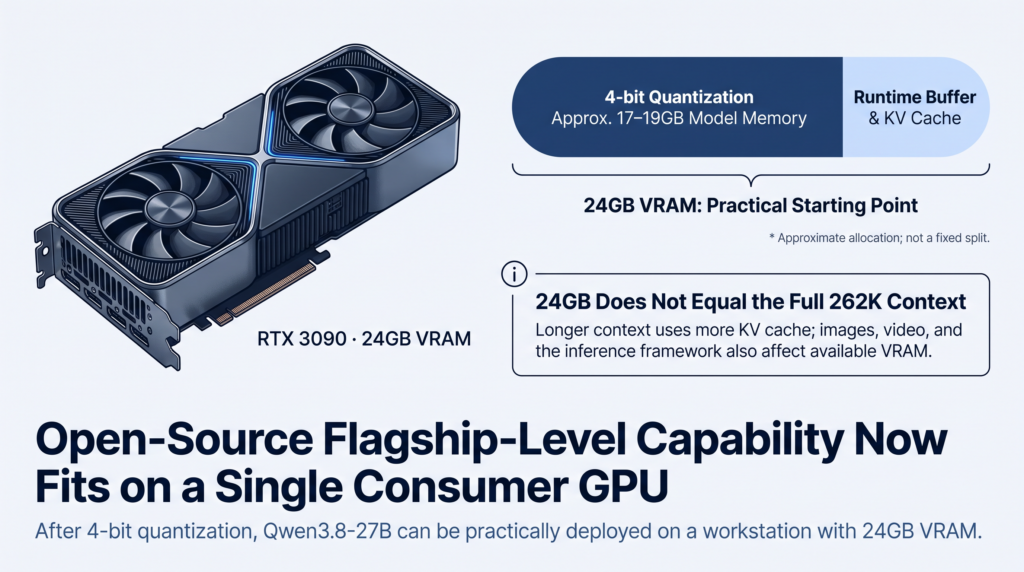
Qwen3.8-27B’s capabilities are noteworthy, but its practical impact still depends on whether ordinary users can deploy it.
With a commonly used 4-bit quantization, they can.
A 4-bit quantized version of Qwen3.8-27B requires roughly 17 to 19GB of RAM or VRAM. In other words, an RTX 3090, RTX 4090, or comparable GPU with 24GB of VRAM can hold the entire model in video memory while leaving some space for runtime buffers and the KV cache.[web:80][web:81][web:88]
The RTX 3090 is therefore a memorable example. It is a consumer GPU introduced in 2020, yet in 2026 it can still host a 27B model with vision, video understanding, reasoning, software development, and agentic capabilities.
However, fitting the model into 24GB of VRAM does not mean the full native context window of 262,144 tokens can be used simultaneously. Model weights occupy only part of memory. Longer inputs require a larger KV cache, while images and video add further memory pressure. For a 24GB GPU, an 8K-to-16K context is a more cautious starting point. Whether 32K or more is practical depends on the inference framework, KV-cache quantization, vision modules, and GPU offloading configuration.[web:87][web:88]
For sustained work on large repositories, hundreds of pages of documents, or long videos, 32GB of unified memory or VRAM is only a more practical starting point; 48 to 64GB provides considerably more headroom. High-concurrency serving, the full 262K-to-1M context range, or higher-precision deployment still calls for professional GPUs, multi-GPU servers, or cloud inference platforms.
The hardware conclusion can therefore be reduced to one sentence:
For Qwen3.8-27B at 4-bit precision, 24GB of VRAM is the most representative practical starting point for single-GPU deployment—not the endpoint for every use case.
When a model that surpasses a closed-source flagship on selected agentic benchmarks can run on a single consumer GPU, local deployment is no longer only an enthusiast experiment. It becomes another option in enterprise architecture—not an attempt to move all intelligence away from the cloud, but a way to redraw the boundaries among privacy, cost, latency, capability, and control.
Local operation does not remove responsibility. A model can run offline without producing reliable outputs. It can call tools without deserving unlimited privileges. It can operate a desktop without being allowed to bypass approval, logging, sandboxing, or human review.
Qwen3.8-27B brings frontier-level capabilities to the personal workstation. The next question is no longer whether ordinary people can own a powerful AI system. It is this: when powerful AI truly enters ordinary computers, how much authority are we prepared to give it?