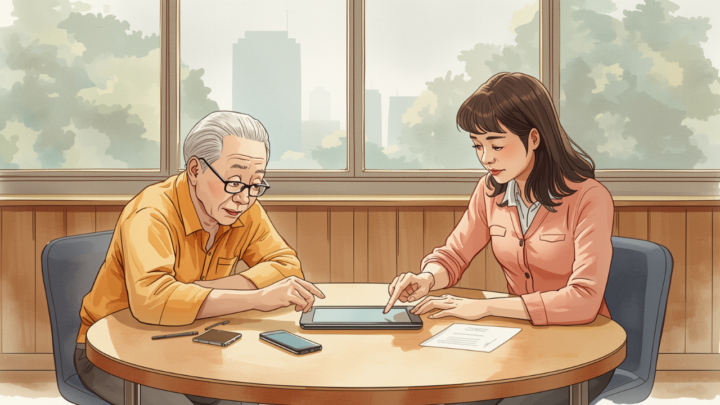

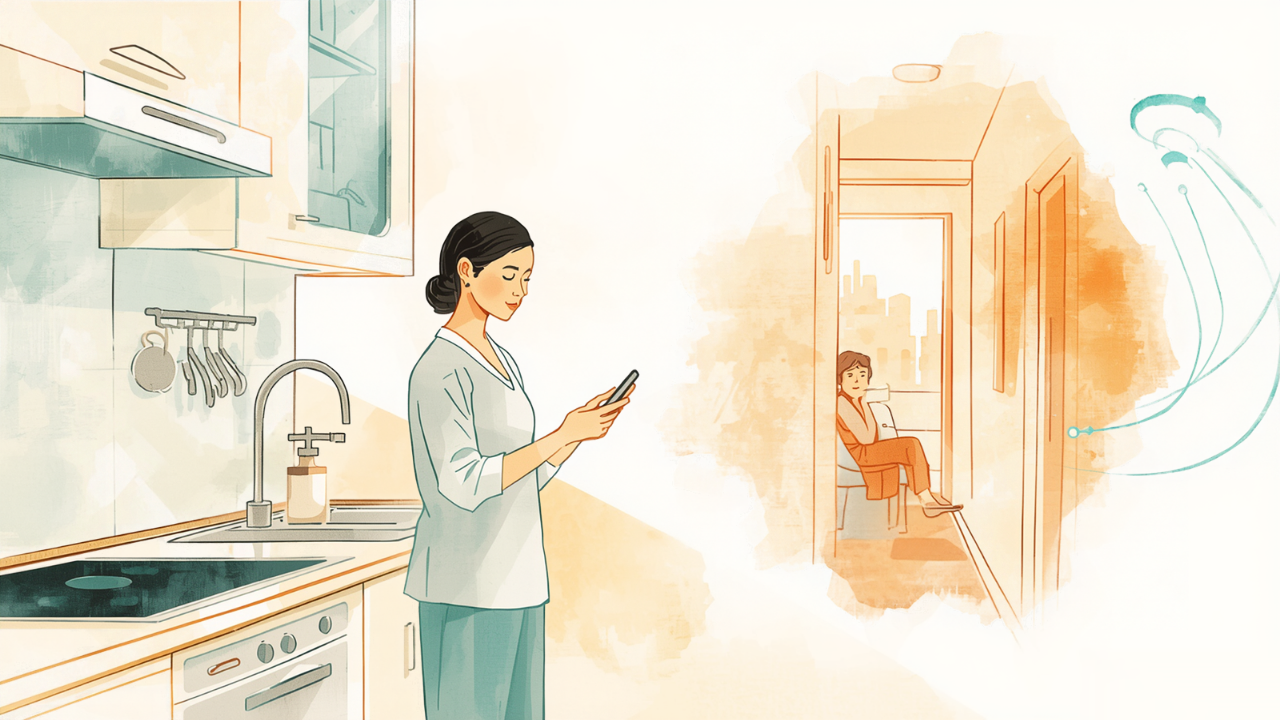
Late afternoon. A door sensor in a public-housing flat does not open at the usual hour. A working adult across town first sees a phone alert, then hears from a support centre. The elder may never have pressed a help button—yet fall detection and activity sensing at home have already asked the question that matters most: is everything all right? That is not science fiction. It is the everyday scene Hong Kong’s official strategy is beginning to make concrete as “ageing in place” meets “smart ageing.”
On 18 September 2026, the Deputy Chief Secretary for Administration, Mr Cheuk Wing-hing, joined by the Secretary for Labour and Welfare, Mr Chris Sun, and the Secretary for Health, Professor Lo Chung-mau, announced the Report on Ageing Society Strategies. The Report puts forward 73 strategic measures across 11 areas. One of those areas—leveraging technology for “smart ageing”—places data platforms, home-safety detection, remote care and smart health on the same policy spine. This article follows that official spine, then shows how millimetre-wave home sensing fits the direction as a lived scene—without claiming citywide roll-out, and without inventing unverified success rates.
Ageing is not a distant horizon: about one in three by 2046
Mr Cheuk said it is projected that by 2046 the population aged 65 and above in Hong Kong will increase to 2.74 million, accounting for more than one-third of the total population—approximately one in three residents will be an elder. The full Report uses the same order of magnitude: about 36% of the population. The Working Group on Ageing Society Strategies was established in November 2025, led by the Deputy Chief Secretary with the Secretary for Labour and Welfare as deputy leader; members include all 15 policy bureaux and the Chief Executive’s Policy Unit. Five consultation sessions were held.
The strategy is not only about residential care homes. The Report notes that most elderly people prefer to age in familiar communities and at home. Residential care, community care, cross-boundary elderly care and the silver economy run in parallel with technology measures. The Labour and Welfare Bureau (LWB) will increase subsidised long-term care places for the elderly by around 3,500 by end-2027. The technology chapter’s job is to fill the gap between tight care manpower and the preference for home living—with earlier risk identification and a shorter distance to help.
“Smart ageing”: from data to sensors at home
Chapter 6 of the Report breaks the agenda into checkable building blocks:
Welfare information sharing e-platform. The LWB will establish the platform in phases to integrate social welfare data of relevant government departments (including the Social Welfare Department, Housing Department and Health Bureau) and non-governmental organisations, and use AI to enable early identification of high-risk individuals or families for timely intervention and targeted resource deployment.
Carer support data platform. The platform already covers about 21,000 people. The SWD has initially identified about 3,000 high-risk households in “three-nil” buildings and is mobilising Care Teams for phased home visits so they can be brought into the platform. The SWD expects to complete upgrades to intelligent database operation within 2026; expansion must comply with the Personal Data (Privacy) Ordinance.
AI for Welfare Lab. The LWB will convene social welfare organisations, scholars, research institutions and the technology sector to identify application scenarios and fund the development and pilot of AI solutions.
Home-safety technology. In March 2026 the LWB launched a two-year Pilot Scheme on Installing Intelligent Accident Detection Systems, covering no fewer than 300 high-risk households of elderly singletons or doubletons and carers of persons with disabilities within the year. The scheme is sponsored by the HKEX Foundation; Hong Kong Shue Yan University is commissioned to evaluate reliability and usability. The Housing Authority assisted the Senior Citizen Home Safety Association in launching the “Care-on-Call Safety Detection Service” pilot from December 2025, installing indoor fall-detection sensors in about 200 elderly singleton or doubleton households in public rental housing and Home Ownership Scheme courts. Sensors detect falls or prolonged inactivity; once triggered they connect automatically to a 24-hour support centre, where staff check on residents by two-way communication and, if needed, notify designated contacts or call the Police. The Housing Department is also trialling an IoT door-sensor system for elderly households in estates with larger elderly populations, extending in 2026 to estates including Tung Wui Estate and Tin Yan Estate. Since 2024, CLP has used smart-meter consumption data to help flag unusual electricity use among elderly singleton and doubleton households and notify welfare organisations and carers.
Remote care and the I&T Fund. The LWB and SWD are exploring online or hybrid remote care, tentatively for social welfare organisations to test within 2026. As at July 2026, the Innovation and Technology Fund for Application in Elderly and Rehabilitation Care had allocated about $1 billion, subsidising roughly 2,200 service units to procure or rent more than 30,000 technology products.
The shared logic is clear: technology shortens the time between something going wrong and someone knowing—without replacing human care with cameras.
mmWave in the living room: where policy meets market offerings
Official texts speak of “fall detection sensors,” “intelligent accident detection systems” and 24-hour support workflows. At the Senior Citizen Home Safety Association’s 30th-anniversary forum on 14 September 2026, the Financial Secretary, Mr Paul Chan, publicly noted the Association’s trial of intelligent accident detection that combines millimetre-wave technology with AI to detect falls without capturing images. His direction was plain: technology can make elders safer and ease carers’ burden, but nothing replaces genuine human concern.
In the market, communications providers and partners have also introduced packages that combine a wireless home emergency safety bell with mmWave radar fall detection, and extend to smoke, water-leak, door and activity sensors linked to 24-hour support. Non-contact sensing, no need for the elder to press a button first, and no camera as a premise—these traits match the privacy-sensitive home setting the official agenda emphasises. This article does not adopt detection-success percentages that are not verified in the government Report. Terms of service, installation conditions and coverage vary with flat layout; whether any commercial product is included in a government pilot should be checked against the relevant scheme announcements.
The meeting point is not “buy a gadget.” It is three layers of connection: whether sensing triggers reliably; whether a support centre can confirm and escalate at once; and whether carers and welfare networks receive actionable information. The Report’s pilots, public-housing trials and data platforms are precisely tests of whether those three layers can become sustainable services.
What this means for households (fact-bound)
Official materials sketch a “bring risk forward” path: high-risk households first for detection pilots; public-housing and HOS trials of fall sensors and door-open alerts; welfare and carer data platforms to identify families needing earlier intervention. The Financial Secretary also noted that the share of elderly-only households is projected to approach one-third by 2046—home-safety demand will rise with the structure of society.
The boundaries are equally clear: pilots have household counts and durations; expansion depends on evaluation; data platforms are bound by privacy law; remote care is still on trial. What readers can verify today is direction, roles and timetables—not a claim that every elder’s home already has mmWave. For carers, a practical expectation is that, under eligible or pilot arrangements, the vacuum of “fallen with no one knowing” shrinks, and time saved can return to visits and companionship—consistent with the public message that technology exists to serve people.
Closing
The Report on Ageing Society Strategies turns “smart ageing” into an executable set: data to spot risk, an AI lab to incubate solutions, home detection to shorten the path to help, and remote care for flexibility. Millimetre-wave and camera-free fall detection are the piece of that set most visible in the living room and corridor. When about one in three residents is an elder by 2046, success will be measured by how many high-risk households are reached in time. Implementation still depends on pilot evaluations and subsequent expansion announcements.
Primary sources
- Government press release: Government announces Report on Ageing Society Strategies (18 Sep 2026) https://www.info.gov.hk/gia/general/202609/18/P2026091800542.htm
- Chinese GIA twin: https://www.info.gov.hk/gia/general/202609/18/P2026091800285.htm
- Full Report (CSO): https://www.cso.gov.hk/eng/links/rass.htm (PDF: https://www.cso.gov.hk/eng/pdf/Report-for-Ageing-Society-Strategies_EN.pdf)
- FS speech at Senior Citizen Home Safety Association 30th-anniversary forum (14 Sep 2026) https://www.info.gov.hk/gia/general/202609/14/P2026091400331.htm