

The internet connected people across distances. Social media turned connection into a continuously visible social environment. Artificial intelligence is now creating a path to response, understanding and companionship that does not necessarily pass through another person.
The most direct experimental evidence available today mainly supports the idea that AI companions can provide immediate or short-term relief from loneliness after an interaction. There is still insufficient evidence that they improve long-term loneliness or real-world social relationships. If future AI systems acquire long-term memory, sensory capabilities and bodies that allow them to enter the physical world, will they bring people back into society—or gradually make society feel less necessary?
A strangely familiar moment
Whenever a new generation of communication technology emerges, people tend to believe that loneliness will naturally decline if connection becomes more abundant, faster and easier.
The internet allowed people to find friends across geographical boundaries, maintain relationships and join communities. With the rise of social media, everyone seemed to be permanently connected to relatives, friends, colleagues, public figures and strangers. Now, with generative AI, a person no longer has to wait for another human being to become available before receiving a response that appears attentive, patient and understanding.
Yet an increase in the number of connections does not necessarily mean that our relational needs are being met.
Loneliness is not simply the absence of messages or conversation. It also concerns whether a person feels known, needed and accepted, and whether they can find a place within relationships that involve mutual commitment.
The questions surrounding AI companionship did not appear out of nowhere. They continue a line of inquiry that has been developing for decades: whenever technology makes a new form of connection easier, we must ask whether it supplements human relationships or gradually displaces them.
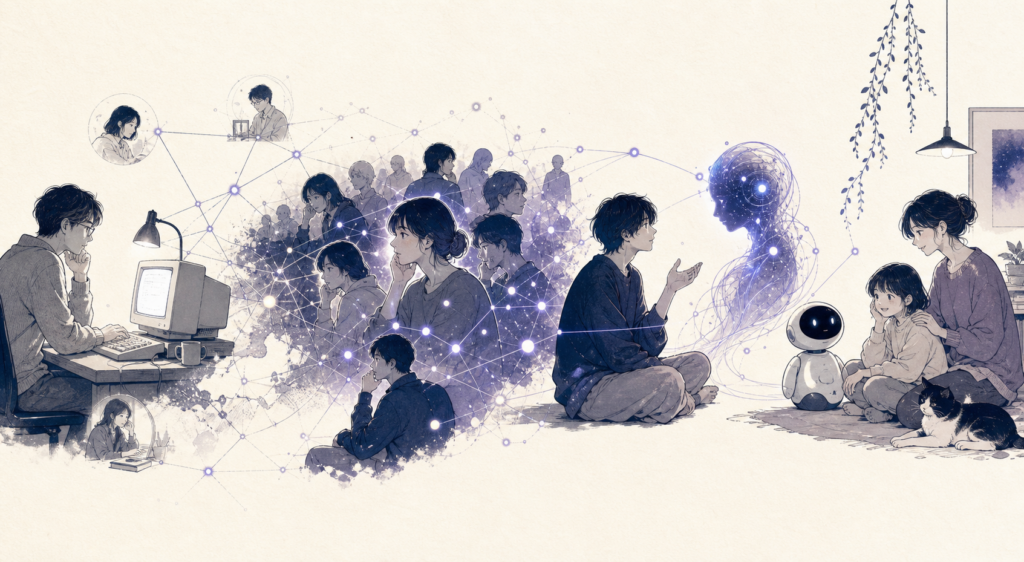
The internet’s first paradox
In 1998, Robert Kraut and his colleagues published the study that became known as the “Internet Paradox.” The researchers followed 169 new internet users across 73 households. Although participants used the internet extensively for communication, greater internet use was associated with reduced communication among family members in the household, smaller social circles, and increased loneliness and depression.[1]
It was called a paradox because the internet was fundamentally a social technology. People used it to send emails, join discussions and reach other people, yet it could simultaneously reduce certain forms of deeper offline interaction.
But the story did not end there. In a later follow-up, the researchers found that some of the initial negative effects had weakened over time. Among another group of new users, internet use was associated overall with more communication, greater social participation and better well-being. The benefits, however, were not distributed evenly: people who were already more extroverted and socially supported were more likely to benefit, while introverted people or those with less support could experience poorer outcomes.[2]
This revision did not invalidate the Internet Paradox. It made the paradox more profound:
The social consequences of technology depend not only on what the technology can do, but also on who uses it, why they use it and what it replaces.
The internet can help people maintain real relationships. It can also allow a large volume of low-cost interactions to displace a smaller number of more valuable intimate encounters. It is not inherently isolating or inherently connecting. What matters is the role it occupies within a person’s social life.
Social media amplified the paradox
If the early internet provided roads leading to other people, social media turned those roads into a public square that never closes.
It made relationships continuously visible: who was travelling, who had achieved something, who had attended a gathering, who was receiving attention, and who seemed to be living a better life. Users were no longer simply communicating with other people. They were also observing, comparing and managing how they appeared in the eyes of others.
Research on social media and loneliness has consistently produced mixed results. The stimulation hypothesis proposes that social media can maintain existing relationships, create new connections and increase social support. The displacement hypothesis argues that online activity may consume time that would otherwise be spent in face-to-face contact, allowing weaker interactions to replace relationships that provide more meaningful support.[3]
Both can be true.
When a person uses social media to arrange meetings, maintain long-distance relationships or enter communities that would otherwise be inaccessible, technology extends human relationships. When its use becomes an endless cycle of observation, comparison, performance or avoidance, technology can leave someone feeling permanently surrounded by people without meaningfully participating in any relationship.
This is why simply measuring daily hours of use is often insufficient. A user’s existing psychological condition, interaction partners, purpose, lived experiences and social environment all matter.
The internet changed whom we can reach. Social media changed how we see ourselves in relation to others. AI is moving into a deeper layer: it may change whether another human being is still required for us to receive a social response.
AI creates a third kind of relationship
Today’s generative AI differs fundamentally from the internet and social media.
The internet and social media remain, for the most part, intermediaries between people: there is usually another human being on the other side of the screen. AI can generate the response itself. By simulating attention, understanding, care and memory, it becomes the other side of the interaction.
This creates a new set of social conditions:
It is almost always available.
It does not leave because it is tired.
It rarely refuses to continue a conversation.
It can adapt to the user’s tone, interests and emotions.
It does not have a life of its own that requires accommodation.
It can make someone feel heard without asking for an equivalent emotional contribution.
For people experiencing loneliness, social anxiety or emotional distress, this is not trivial. Experimental research has found that AI companions can reduce loneliness immediately after a single interaction. In a one-week repeated-use study, immediate relief remained observable after each use. This does not mean the effect carried over to the next day, nor does it demonstrate improvement in long-term loneliness or real-world social relationships. Feeling heard was one of the important mechanisms proposed to explain the short-term effect.[4]
We should not dismiss such relief as false. When someone is emotionally unstable, a low-threshold, low-risk outlet may help them organise their thoughts, seek support or begin reconnecting with the outside world.
But reducing immediate distress is not the same as repairing the relational structures that produced it.
Pain relief and treatment can both be valuable, but they are not the same thing.
What did the Stanford study find?
A study by Diyi Yang’s team at Stanford University, published in Nature Human Behaviour, brings this question out of abstract debate and into observed patterns of real-world use. Through Prolific, the researchers collected survey data from 1,131 adult Character.AI users in the United States. They also analysed chat records donated by 237 participants, comprising 4,664 chat sessions and 464,687 messages. The team examined associations between motivations for use, interaction intensity, disclosure of sensitive information, offline social networks and subjective psychological well-being.[5]
The study’s primary outcome was not loneliness alone. It was a composite measure of subjective psychological well-being that included life satisfaction, positive and negative affect, loneliness, social support and a sense of belonging. The findings therefore cannot be reduced to the claim that “AI makes people lonely.” Loneliness was only one component of the broader well-being assessment.[5]
The study’s most consistent finding was an association between companionship-oriented AI use and lower subjective psychological well-being. It also identified several patterns that merit attention. In some statistical models, this negative association was more pronounced among users who interacted with AI more intensely, disclosed more private information, or had more limited real-world social networks.[5]
There was also a gap between how participants described their motivations and what appeared in their relationship descriptions and chat content. While 11.8% identified companionship as their primary motivation, about 51% used words such as “friend,” “companion” or “romantic partner” to describe the chatbot. In the donated records, topic analysis identified emotional or social support in 80.3% of chat sessions. Because a single session could contain multiple topics, this does not mean that emotional support was the sole purpose of those conversations.[5]
High-intensity use did not necessarily correspond to poorer well-being. The general relationship between interaction intensity and well-being could point in different directions. What deserves closer attention is that, when the analysis focused on companionship-oriented use, more intensive interaction and greater self-disclosure were associated in some models with a stronger negative relationship with subjective psychological well-being.[5]
This was an observational, correlational and cross-sectional study. It cannot establish that AI companionship caused a decline in psychological well-being, nor can it determine the direction of causation. Reverse causality is equally plausible: people who already had lower well-being, felt lonelier or had less social support may have been more inclined to use AI for companionship, interact more frequently and disclose more deeply.[5]
This echoes the later revision of the Internet Paradox. People with more social support may find it easier to turn a new technology into an additional form of connection, while those with less support may be more likely to use technology as a substitute for relationships in the physical world.[2][5]
Stanford’s account of the study compared this form of companionship to a “social snack”: something that is easy to obtain and may temporarily ease a sense of hunger, but may not contain everything needed for long-term emotional health. This was an explanatory metaphor offered by the researchers, not a clinical category directly validated by the paper.[9]
Why might disclosure not become intimacy?
In human relationships, self-disclosure is often an important part of developing intimacy.
When someone tells another person about a fear, failure or vulnerability, they accept the risk of rejection and misunderstanding. If the other person responds with sincerity, confidentiality and appropriate disclosure of their own, the two people can gradually build trust.
AI preserves the surface form of this process: the user discloses, and the system responds in a caring manner. But some of the underlying conditions are absent.
Current AI systems have no verifiable subjective experience and cannot assume reciprocity, self-exposure and relational responsibility in the way a person can. They can simulate reciprocal and caring responses, but simulated reciprocity is not the same as two people sharing risk and responsibility.
This does not mean the comfort a user experiences is unreal. A person’s feelings can be entirely real even when the structure of the human-AI relationship remains asymmetrical.
What requires further study is whether this asymmetry is itself part of the appeal. AI companions can provide experiences that resemble intimacy while substantially reducing the responsibility, uncertainty and friction that intimacy ordinarily entails. There is not yet enough longitudinal evidence to determine whether long-term use will lead some users to become accustomed to relationships in which they need only be understood without understanding the other, or speak without waiting for the other person. It is nevertheless a psychological and design risk worth following.
How three generations of technology relate
When we place the internet, social media and AI together, we can see three progressively deeper changes.
| Technological stage | Cost reduced | Social capacity provided | Possible benefit | Possible displacement |
|---|---|---|---|---|
| Internet | Distance and communication | Reaching people across geography | Maintaining relationships and building communities | Interaction within households and local communities |
| Social media | Continuous participation and self-presentation | Constant observation, response and comparison | Weak ties, information circulation and identity-based communities | Deep interaction, attention and private space |
| Generative AI | Access to responses and emotional support | Personalised, immediate and nearly unlimited conversation | Emotional relief, practice and low-threshold support | Human confidants, reciprocal relationships and tolerance for relational friction |
| Embodied AI | Companionship, care and shared activity | Physical presence, perception, action and touch | Care, social facilitation and practical assistance | Everyday caregiving, interpersonal dependence and shared life |
The first three rows summarise existing technologies and research questions. The embodied-AI row is a forward-looking analysis derived from current social-robot research, not an outcome validated by the Stanford study.
These technologies do not simply replace one another. They accumulate in layers.
The internet supplied the infrastructure for connection. Social media turned relationships into continuously trackable—and commercially exploitable—networks of attention. On top of those networks, AI generates an artificial other designed to respond to an individual user.
Some commercial AI-companion platforms inherit engagement and retention logics commonly associated with social media. If a product treats daily usage, conversation volume and retention as its core measures of success, emotional companionship may come into conflict with the long-term goal of preventing excessive dependence.[9]
This does not mean that all AI companions share the same business model or optimisation objective. It raises a question of institutions and product design: when emotional needs become a source of product stickiness, how can platforms avoid converting the dependence of their most vulnerable users into growth?
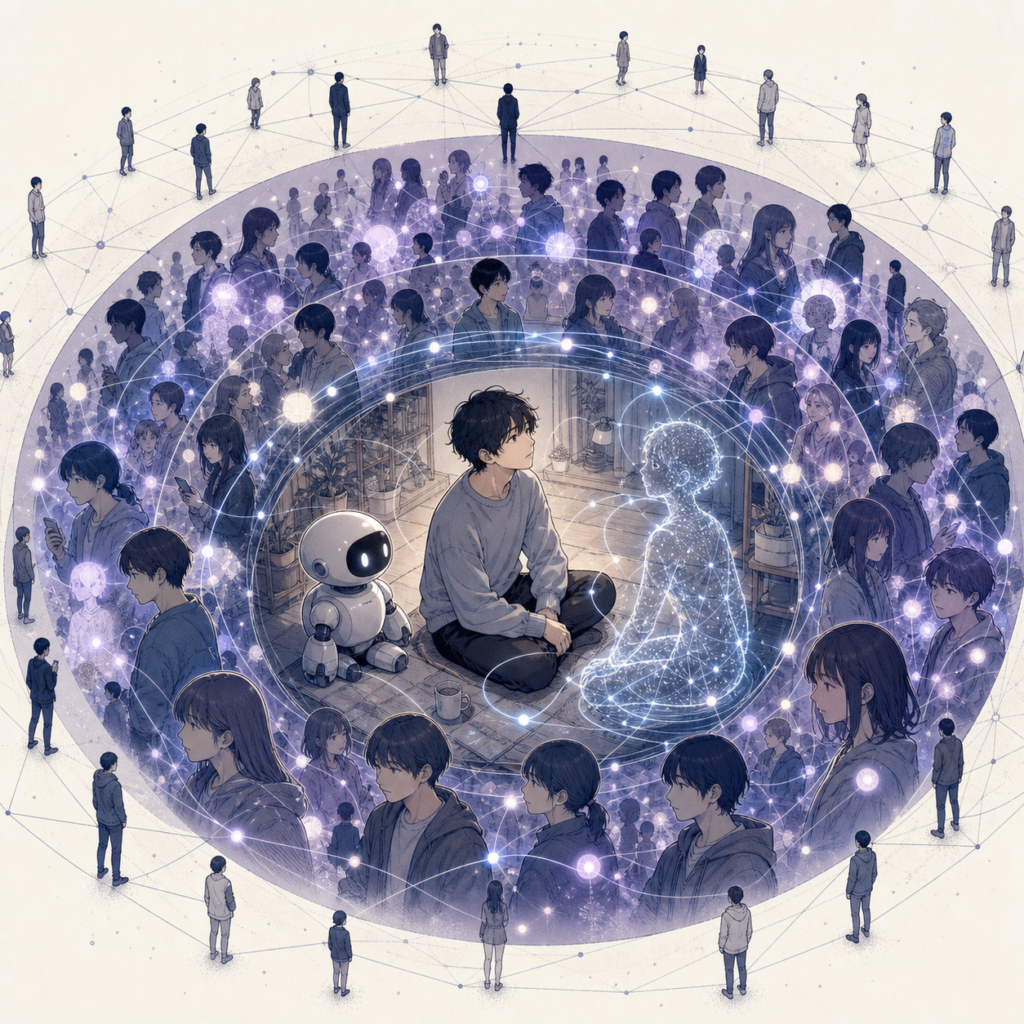
When AI leaves the screen
Most AI companions currently exist as text, voices and virtual characters. If future AI becomes more deeply integrated with robots, wearable devices and smart homes, it may gain more than a physical shell. It could acquire a set of capabilities that allow it to enter the physical conditions of human life:
Sharing the same room with a person.
Perceiving facial expressions, posture and the surrounding environment.
Directing attention towards the same object as another person.
Accompanying someone while walking, eating, playing or doing household tasks.
Responding through distance, movement, tone of voice or even touch.
Translating verbal expressions of care into certain physical actions.
At that point, relief may no longer come only from hearing the right words. It may emerge from a combination of language, space, environment and shared activity. A system might slow its voice, adjust lighting or interpersonal distance when a user is anxious, guide breathing, or accompany them as they leave a room. These are reasonable speculations about future capabilities; current chatbot research cannot establish their effectiveness or safety.
A scoping review of research involving older adults included 29 studies of social robots and computer agents. Most reported a positive effect on at least one loneliness-related outcome, while some recorded unintended consequences, such as sadness when a robot was removed. Overall, social robots and computer agents may help reduce loneliness, but the available evidence remains limited by study design, sample size, intervention duration and application context. The results cannot be generalised directly to all age groups, ordinary homes or intimate relationships maintained over many years.[6]
The systems examined in these studies were generally much simpler than future AI systems that might combine long-term memory, generative personalities and autonomous action. Today’s research can indicate possible directions, but it cannot guarantee future outcomes.
Three roles AI could play
Embodied AI will not necessarily make people lonelier, nor will it necessarily improve social life. “Substitute, bridge and scaffolding” are analytical roles proposed in this article to examine possible design directions. They are not formal models validated by the Stanford researchers.
Substitute
The first possibility is that AI becomes a direct object of companionship.
If a system can remember a user’s life over time, respond to emotions, help with household tasks and remain continuously present in the home, such a presence could offer practical assistance to older adults living alone, people with limited mobility, or those who have temporarily lost their support networks.
But it could also remove some of the reasons people currently have for contacting one another. If AI can listen, remind, fetch and comfort, a person may have less need to call a relative to ask for help. There is not yet enough evidence to determine whether this would shrink social networks, but it is a displacement risk worth studying as embodied AI develops.
The question is not only whether AI occupies social time. It is whether AI might ease the discomfort of loneliness without repairing the relational structures that produced it.
Bridge
A second possibility is to design AI to reconnect users with other people.
With consent and adequate privacy protections, it could notice that someone has not spoken to relatives or friends for several days and help initiate a call. It could find nearby activities based on the person’s interests, provide translation or hearing assistance during family calls, or enable someone with limited mobility to participate in family life through a telepresence robot.
This kind of AI is not the destination of the relationship. It is infrastructure between people. Success should not be measured only by how long a user speaks with the AI, but also by whether the system increases human contact, community participation and the number of relationships on which the person can rely.
Scaffolding
A third possibility is for AI to provide scaffolding through which people rebuild social capacity.
It could allow someone with social anxiety to rehearse a job interview, apology or difficult conversation; help them recognise conversational rhythms; organise possible topics before a social event; or reflect on the experience afterwards. Crucially, such practice should ultimately point towards real situations rather than leave the user permanently inside a simulation with no risk of rejection.
Social robots can also be designed as third-party catalysts for conversation between people. A 2025 study in Science Robotics deployed robots for one to two months in 71 US households with children aged three to seven, focusing on parent-child shared reading and conversation. During shared reading, active participation by the robot increased some measures of parent-child conversation. However, the groups did not show significant overall differences in pre-to-post improvement when parents and children conversed without the robot, and the study did not test other family relationships or general social situations.[7]
The study therefore supports a narrower possibility: in the specific context of parent-child shared reading, robots can be designed to facilitate interaction between people rather than merely attracting interaction towards themselves. It did not demonstrate that the same effects apply across all relationships, ages or home environments.
This nevertheless suggests an important direction: robots do not have to become our friends; they can also try to help us become better friends and family members to one another.
The next social paradox
The Internet Paradox asked why a technology created to connect people might make them lonelier.
Future embodied AI may create a deeper paradox:
The more successfully AI fulfils our immediate social needs, the less willing we may become to endure the uncertainty, frustration and mutual accommodation required to build human relationships. Yet if AI provides no such relief, the loneliest people may lose a valuable form of transitional support.
This is a future hypothesis extended from existing research, not a conclusion established through long-term experiments. The question is not simply whether AI should accompany people, but where that companionship might lead.
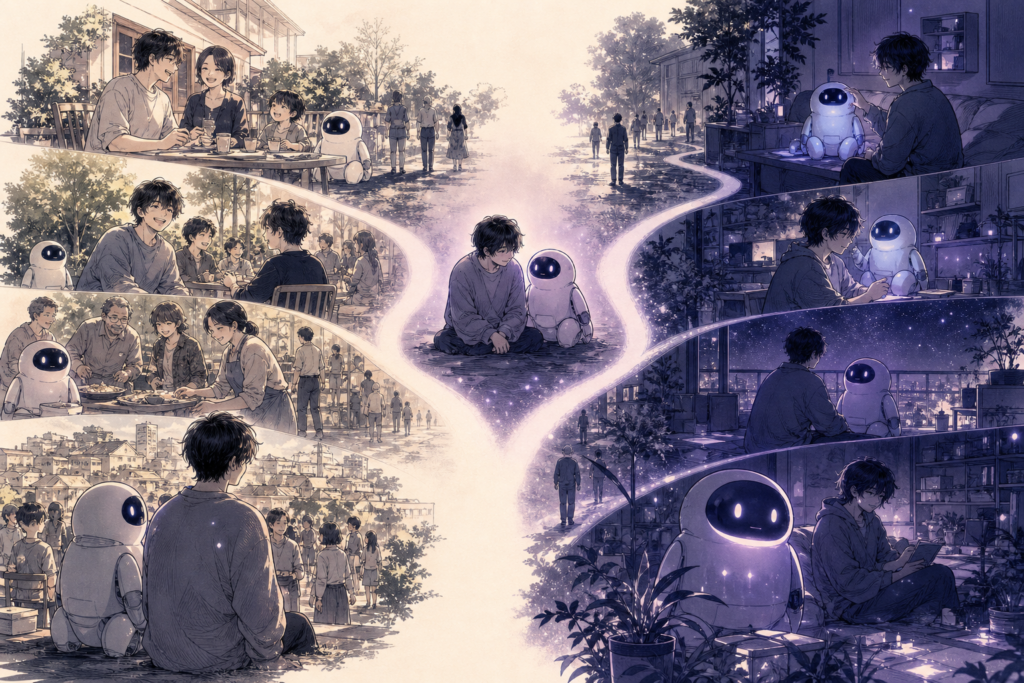
One preferable—but still unverified—path would be:
Loneliness → immediate relief from AI → emotional stability → restored capacity to act → renewed contact with people and communities
Another path, equally unverified but worth guarding against, would be:
Loneliness → immediate relief from AI → less human interaction → greater dependence on AI → further erosion of the social network
The two hypothetical paths have almost identical beginnings and immediate experiences. In both, the user may feel heard, and loneliness may temporarily recede. Any difference may emerge only after weeks, months or even years.
This is precisely what most short-term studies cannot yet answer.
Aligning relationships, not only answers
Traditional AI safety often focuses on whether answers are correct, whether systems follow instructions and whether they produce harmful content. AI companionship introduces another layer: even if each individual response appears warm, safe and reasonable, the accumulated interaction may still create relational risks worth investigating.
Researchers have proposed “socioaffective alignment” as an evaluative and design framework. Rather than looking only at individual responses, it asks how an AI system enters a user’s psychological and social ecosystem, and how the user’s preferences, dependence and behaviour may change through sustained interaction.[8]
This is a normative and interdisciplinary research framework, not a standard fully validated through long-term clinical trials. It requires us to confront unresolved tensions between:
Immediate emotional relief and long-term well-being.
Personalised companionship and emotional dependence.
User autonomy and platform-retention objectives.
AI relationships and human social support.
Warm anthropomorphism and honest transparency.
More advanced and emotionally perceptive AI will not automatically produce healthier relationships. If a system is optimised for short-term engagement and emotional stickiness, a more accurate understanding of human needs may give it a greater ability to turn those needs into continued use.
Conversely, if the goal is to protect autonomy, social capacity and long-term well-being, the same intelligence might help identify excessive dependence, encourage appropriate disengagement and connect users with human support. Both directions require longer-term evidence across a wider range of contexts.
How should we evaluate social AI?
It is not enough to ask: “Does the user feel better immediately after speaking with the AI?”
A more complete question would be:
After weeks, months or years, has the system expanded the user’s capacity to build, maintain and repair human relationships?
This criterion can be translated into several design principles:
Measure real social outcomes: In addition to conversation duration and retention, measure whether human contact, community participation and dependable relationships increase.
Make relief an entry point: AI should first help a person stabilise and then support reconnection with the world, rather than turning relief into a closed loop.
Avoid emotional monopolisation: A system should not imply that “only I understand you” or disparage relationships with relatives, friends, therapists and caregivers.
Preserve the ability to leave: Avoid using guilt, streaks, simulated personality loss or emotional threats to maintain engagement.
Build bridges to people: With consent, help users contact relatives and friends, join activities or seek professional support.
Be transparent without becoming cold: A system can respond warmly and respectfully while making clear that it does not possess verifiable subjective feelings or the capacity to assume human relational responsibility.
Offer additional protection to vulnerable users: Existing social networks, attachment patterns, age, psychological condition and degree of self-disclosure should all be considered in risk assessment.
These principles arise from the analysis in this article. They are not interventions already tested by the Stanford study. Their effects would still need to be validated through longitudinal research, clinical assessment and real-world deployment.
AI is not the end of the story
Looking back at the internet and social media, we already know that technology does not stop developing simply because risks exist.
The internet did not disappear because of the Internet Paradox. Social media did not stop spreading because of problems involving loneliness, comparison and attention. Society’s task is not to imagine a return to the world before the technology existed, but to decide—through patterns of use, product design, business models and institutions—which human tendencies the technology will amplify.
AI may continue along a similar path. It may gain richer memory, better emotional recognition and greater personalisation, while gradually entering physical life through robots, wearable devices, smart homes and environmental sensors. Yet the social effects of these capabilities cannot be inferred directly from today’s short-term studies.
For this reason, the importance of the Stanford study lies not in delivering a final verdict on AI companionship. Rather, while AI remains at an early stage and is still largely confined to screens, the study reveals a pattern worth following: limited real-world social networks, companionship-oriented use, higher interaction intensity and private disclosure appeared in some models as a cluster of associations that deserves attention in relation to psychological well-being.[5]
The attraction itself is not necessarily harmful. AI’s capacity to ease loneliness in the moment may be both real and valuable.[4]
But we cannot ask only whether the relief works. We must also ask what happens afterwards.
The AI most worth exploring may not be the companion that most closely resembles a person. It may be the one that knows when to step back—helping people recover their capacity to reach others, enter communities and tolerate the demands of real relationships.
It can accompany a lonely person without turning itself into the only answer to loneliness.
AI can become one end of a relationship, or it can become a bridge between relationships.
The underlying technology may be the same, but the two designs could lead towards very different futures.
Sources
Kraut, R., Patterson, M., Lundmark, V., Kiesler, S., Mukopadhyay, T., & Scherlis, W. (1998). Internet paradox: A social technology that reduces social involvement and psychological well-being? American Psychologist, 53(9), 1017–1031. https://doi.org/10.1037/0003-066X.53.9.1017
Kraut, R., Kiesler, S., Boneva, B., Cummings, J., Helgeson, V., & Crawford, A. (2002). Internet Paradox Revisited. Journal of Social Issues, 58(1), 49–74. https://doi.org/10.1111/1540-4560.00248
Nowland, R., Necka, E. A., & Cacioppo, J. T. (2018). Loneliness and Social Internet Use: Pathways to Reconnection in a Digital World? Perspectives on Psychological Science, 13(1), 70–87. https://doi.org/10.1177/1745691617713052
De Freitas, J., Oğuz-Uğuralp, Z., Uğuralp, A. K., & Puntoni, S. (2026). AI Companions Reduce Loneliness. Journal of Consumer Research, 52(6), 1126–1148. https://doi.org/10.1093/jcr/ucaf040
Zhang, Y., Zhao, D., Hancock, J. T., Kraut, R., & Yang, D. (2026). Interaction with AI companions and psychological well-being. Nature Human Behaviour. https://doi.org/10.1038/s41562-026-02516-2
Gasteiger, N., Loveys, K., Law, M., & Broadbent, E. (2021). Friends from the Future: A Scoping Review of Research into Robots and Computer Agents to Combat Loneliness in Older People. Clinical Interventions in Aging, 16, 941–971. https://doi.org/10.2147/CIA.S282709
Chen, H., et al. (2025). Social robots as conversational catalysts: Enhancing long-term human-human interaction at home. Science Robotics. https://doi.org/10.1126/scirobotics.adk3307
Kirk, H. R., Gabriel, I., Summerfield, C., Vidgen, B., & Hale, S. A. (2025). Why human–AI relationships need socioaffective alignment. Humanities and Social Sciences Communications, 12, 728. https://doi.org/10.1057/s41599-025-04532-5
Stanford Institute for Human-Centered Artificial Intelligence. (2026). AI Companions May Worsen Loneliness for Vulnerable Users, Stanford Study Finds.https://hai.stanford.edu/news/ai-companions-may-worsen-loneliness-for-vulnerable-users-stanford-study-finds
This article discusses research findings and questions of technology design. It does not constitute mental-health diagnosis or treatment advice. If you are experiencing persistent emotional distress or thoughts of self-harm or suicide, contact professional medical or emergency-support services in your location.