

A feature published by news.gov.hk on 6 October 2026 sets out how the Environmental Protection Department (EPD), under the co-ordination of the AI Efficacy Enhancement Team, is using artificial intelligence to work faster and more efficiently. The Hong Kong Environmental Database has roughly halved the time needed for environmental impact assessments (EIAs), while an AI bird monitoring and identification system and a Smart Detect Dog are strengthening environmental monitoring and enforcement. The department is also developing an AI-assisted platform for reviewing tender documents.
EIA: from visiting department after department to one-stop access
The EPD handles about 10 to 20 EIA reports each year for major infrastructure projects and new development areas. Consultants responsible for these projects used to go from department to department to collect baseline data, then compile and analyse it — a process that could take months or even a year.
The Hong Kong Environmental Database consolidates decades of local environmental data covering air quality, water quality, noise and ecology, converted into about 200 geographic information layers that project teams can consult in one place. The system also offers smart analysis and online assessment functions, allowing teams to simulate different scenarios at the early planning stage and avoid ecologically sensitive areas, saving construction cost and time.
Deputy Director of Environmental Protection Dr Vanessa Au said an EIA project used to take 36 to 48 months overall. With the comprehensive data provided by the database, the time required has been shortened to 15 to 24 months, a saving of about 50 per cent. The cost for project proponents and consultants to prepare an EIA has also fallen by 30 per cent.
| Stage | Before | Now (per government information) |
|---|---|---|
| Overall EIA project | About 36–48 months | About 15–24 months (about 50% saved) |
| Cost of preparing an EIA | — | 30% lower |
| Tree baseline survey | About 7–8 hours by hand | About 2 hours with LiDAR (about 70% shorter) |
| Environmental monitoring | Up to 15 site visits a month | Round-the-clock real-time IoT sensing, no site visits needed |
| Bird monitoring | Monthly manual surveys | Continuous real-time monitoring |
| Tracing unknown gases | More than two days | Expected one day, or even within a few hours |
Figures in the table for tree surveys, environmental monitoring, bird monitoring and gas tracing are taken from the annex to the Government's 17 August 2026 announcement of the AI Efficacy Enhancement Team's first batch of projects.
Ecological monitoring: round-the-clock AI birdwatching
Alongside smart EIA, the EPD has introduced a range of advanced technologies to strengthen environmental monitoring and assessment. Tree surveys now use three-dimensional laser scanning (LiDAR) to calculate tree height and crown width quickly and precisely.
The department has also developed an AI bird monitoring and identification system that provides 24-hour continuous monitoring to assess how works projects may affect bird habitats and other ecology. Dr Au noted that with traditional manual monitoring, staff might need to observe for two or three hours a day just to have a chance of spotting certain species. After training, the system can now identify more than 500 bird species found in Hong Kong, with accuracy above 80 per cent.
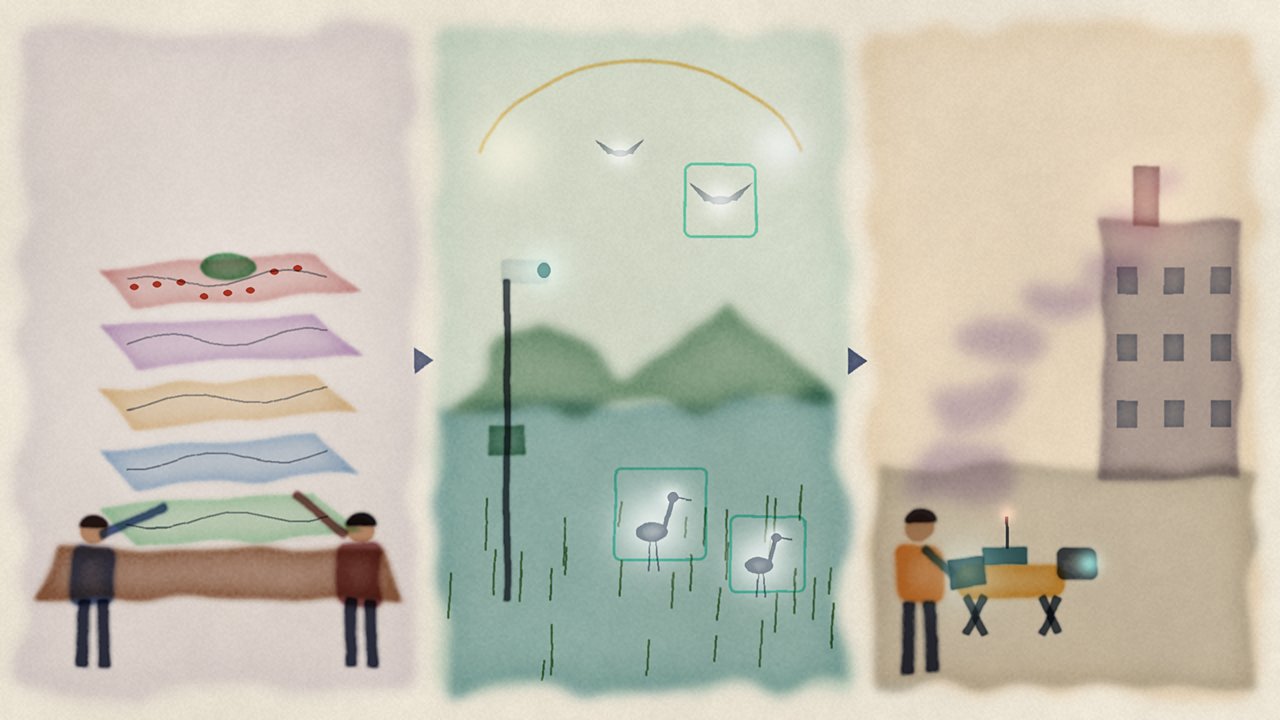
Figure: Left to right — a planning team studies stacked environmental map layers, a monitoring camera beside a wetland records birds around the clock, and a Smart Detect Dog helps an officer trace the source of an odour (editorial illustration — no text or logos; not an actual system screen).
Pollution investigation: the Smart Detect Dog "Zhiao"
To strengthen enforcement and pollution monitoring, the EPD developed its own Smart Detect Dog, equipped with nine sets of air detectors, GPS and a thermal imaging camera. It can distinguish dozens of odours and has begun pilot use.
According to the AI Efficacy Enhancement Team's first-batch project information, "Zhiao" combines AI and big data with real-time kinematic positioning, gaseous sensors and thermal imaging cameras. Dozens of odour sources have been identified so far, including sewage treatment plants, poultry farms and cooking fumes.
Dr Au said that analysing the source of an unknown odour used to take about two days; with the detection dog, the source can be pinpointed within a day, or even within a few hours. When dangerous gases are involved, it also helps keep staff safe, while helping residents get pollution problems resolved sooner.
Next: a tender document review platform
The EPD is developing a tender document review platform that uses AI to help detect possible human errors and discrepancies in tender documents at an early stage. It is expected to launch in the fourth quarter of 2026.
Flagship projects of the AI Efficacy Enhancement Team
The AI Efficacy Enhancement Team was announced in the 2025 Policy Address. Led by the Deputy Chief Secretary for Administration, it co-ordinates and steers government departments in applying AI effectively to their work and exploring process re-engineering. On 17 August 2026 the Government announced that the Team had facilitated and implemented a first batch of 30 Efficacy Enhancement Projects across 13 departments, including 10 flagship projects; the EPD's "AI Environmental Impact Assessment" and its Smart Detect Dog "Zhiao" are both among the flagships. Deputy Chief Secretary for Administration Mr Cheuk Wing-hing said at the time that departments share similar workplace scenarios, such as audits and assessments, responding to enquiries and environmental monitoring; where a solution succeeds in a pilot department, the experience, technologies and operating models can be extended, with suitable adjustments, to other departments and similar work scenarios.
Primary sources:
- news.gov.hk, 「善用人工智能 環保署提速提效」 (Chinese-language feature), 2026-10-06, https://www.news.gov.hk/chi/2026/10/20261005/20261005_160527_884.html
- Government press release, "AI Efficacy Enhancement Team announces implementation of 30 Efficacy Enhancement Projects" (2026-08-17), https://www.info.gov.hk/gia/general/202608/17/P2026081700324.htm ; annex: https://gia.info.gov.hk/general/202608/17/P2026081700324_554949_1_1786948875332.pdf
- Environmental Protection Department, Hong Kong Environmental Database (HKED), https://hked.epd.gov.hk/map/en/Map