
Policy Address 2026: Commissioner for AI, Seven Risk-Governance Tracks, and Building the “AI City Brain”
Development with governance—timelines, budgets, and stated official safeguards
Development with governance—timelines, budgets, and stated official safeguards
The LegCo Secretariat's latest Feature Brief outlines the Hong Kong Government's key policy measures on AI+, covering computing infrastructure, embodied intelligence, AI governance, and Greater Bay Area collaboration, alongside recommendations raised by Legislative Council members.
The internet connected people across distances. Social media turned connection into a continuously visible social environment. Artificial intelligence is now creating a path to response, understanding and companionship that does not necessarily pass through…
In recent years, many employees have encountered the same contradiction: they have learned to use ChatGPT, Copilot, automated workflows, and even AI agents. Their work is genuinely faster and their output has increased, yet…
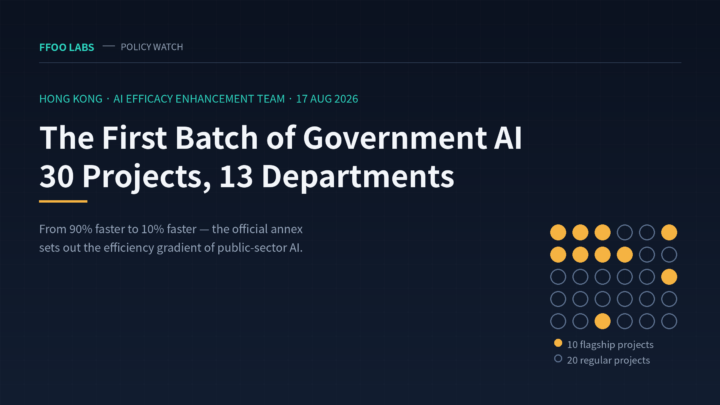
Hong Kong has published its first batch of 30 government AI projects. The part worth reading is not the headline \"90 per cent faster\" — it is the official annex, which sets out the projects, their rollout windows and their stated performance targets in one place.
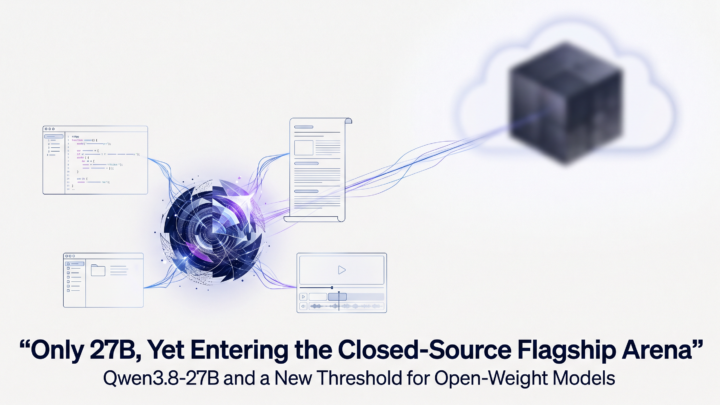
The most surprising thing about Qwen3.8-27B is not how many benchmarks it has improved. It is that a dense model with only about 27.8 billion parameters has matched or even surpassed Claude Opus 4.6 Max on selected software development, office-agent, and computer-use benchmarks. Looking back at the evolution from Qwen3-32B through Qwen3.5-27B and Qwen3.6-27B, a different competitive strategy becomes visible: the models are not getting larger, but the work they can complete independently is getting longer. More importantly, after commonly used 4-bit quantization, Qwen3.8-27B can be deployed on a single consumer GPU with 24GB of VRAM.
xAI released Grok 4.6 on 12 August 2026, roughly one month after Grok 4.5. The headline of this release is not a bigger parameter count — the company declined to disclose one — but a deliberate focus on long-running agents and ambitious interactive visual work: multi-step research, deep work inside large codebases, and turning rough product ideas into polished prototypes.
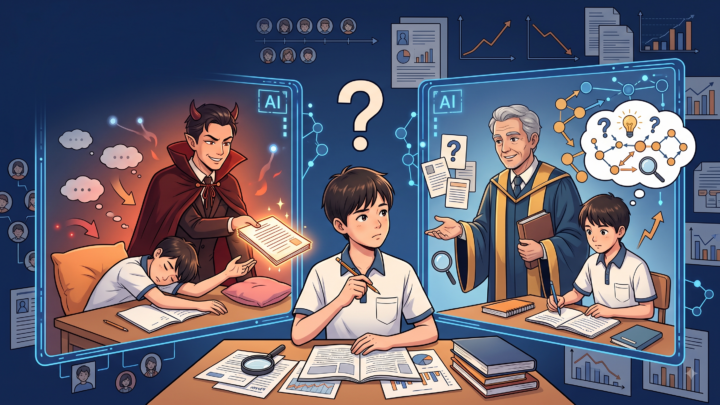
If AI Democratizes Knowledge, Why Are Students Falling Behind? A Study of 26,811 Students Shows Why Understanding Cannot Be Outsourced AI has reduced the cost of accessing knowledge. It has not removed the effort…
In 1950, Alan Turing did not directly answer the question “Can machines think?” He replaced it with a question that could be tested. Seventy-six years later, in a five-minute, text-based, three-party test, GPT-4.5—when given a specific humanlike persona prompt—was selected as the human more often than the actual person with whom it was compared. What does this demonstrate: machine intelligence, linguistic imitation, or the way humans judge intelligence? FFOO Labs’ AI Classics Revisited returns to a question that the imitation game has never brought to an end.