
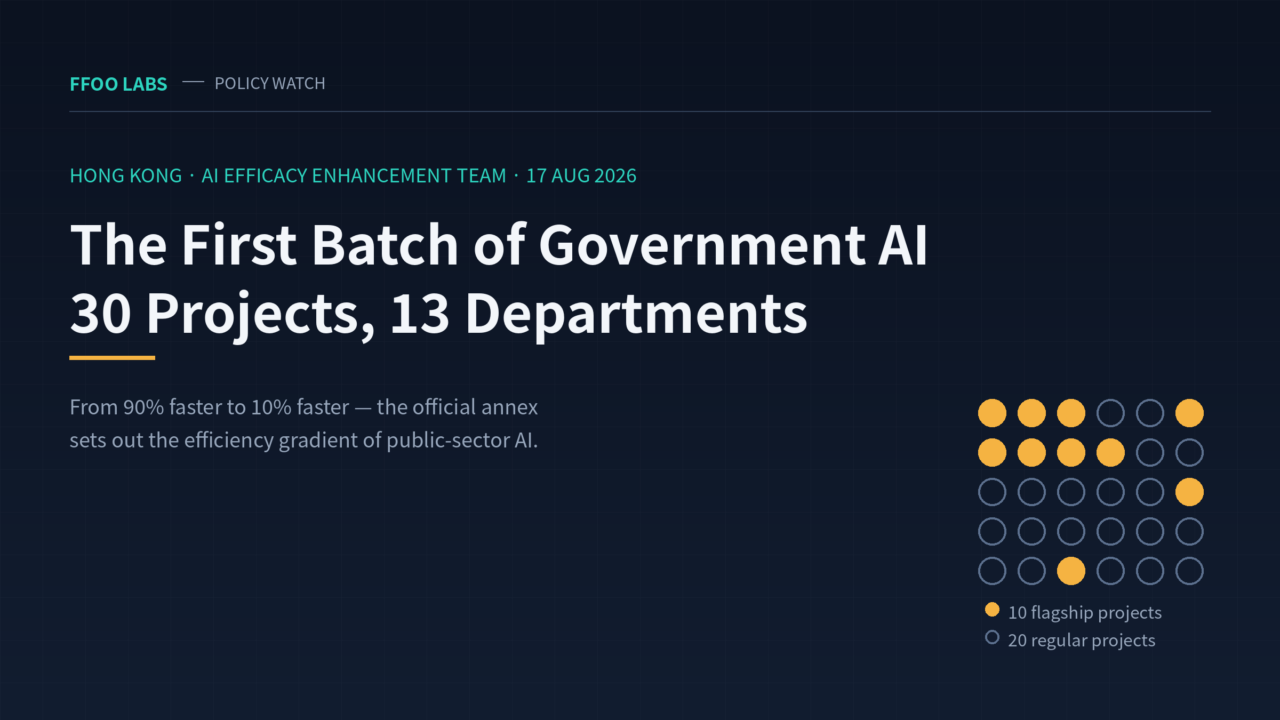
On 17 August 2026 the Hong Kong Government announced that its AI Efficacy Enhancement Team (AIEET) had facilitated and taken forward a first batch of 30 Efficacy Enhancement Projects across 13 departments, 10 of them flagship projects, rolling out in four waves from this year. The figure that carried furthest came from the Deputy Chief Secretary for Administration, Mr Cheuk Wing-hing: through the adoption of AI, “the processing or waiting time for certain cases” would be cut “by 90 per cent”. A number of subsequent reports focused on that figure.
The document worth reading slowly, though, is not the press release. It is the annex attached to it, “Overview of First-Batch Efficacy Enhancement Projects”. It is an unusually detailed public account of the projects, the departments running them, their rollout windows and their stated performance targets. Its value is not that it looks impressive. Its value is that it lets the shape, pace and limits of public-sector AI be checked item by item.
A note on the figures used here: The performance figures in this article are drawn mainly from the Government’s project annex. Except where operational results are explicitly reported, most are projected or expected outcomes. Some percentages are calculated by FFOO Labs from the before-and-after times stated in the annex; they are not independent test results.
The annex tells a fuller story than the headline
The AIEET was announced in the 2025 Policy Address. It is led by the Deputy Chief Secretary for Administration, Mr Cheuk Wing-hing, with the Secretary for Innovation, Technology and Industry and Legislative Council Member Mr Duncan Chiu as Deputy Leaders. A subsequently published overall target is unusually concrete: AI tools covering 100 public administration procedures within 2026, expanding to no fewer than 200 by the end of 2027. Worth noting is that the 100/200 target is not met by these 30 bespoke projects alone — general-purpose offerings such as the Digital Policy Office’s “AI+ Toolbox” catalogue also count towards the coverage of public administration procedures.
The delivery model matters as much as the target. The Team has set up “an AI dedicated task force comprising experts in AI and data science from the Digital Policy Office and the Census and Statistics Department”, and works with leading commercial AI firms as AI technology partners. At the exchange session on “‘AI+’ Civil Service” held the same day, the industry representatives sharing their experience came from Alibaba Cloud, Tencent Cloud and Huawei Hong Kong & Macau. This points to a delivery model that combines an internal task force with commercial technology partners. The Government has not, however, said whether those three companies are involved in any of the first 30 projects, nor has it disclosed the vendors or models used by individual projects.
One passage from Mr Cheuk sets out the methodology behind the whole list:
Despite the diverse functions and responsibilities of different departments, there are similarities in daily workplace scenarios, such as online reservations, license applications, audits and assessments, responding to enquiries and environmental monitoring. If a solution could be successfully applied in a pilot department, the relevant experience, technologies and operation models can be extended to other departments and similar work scenarios with suitable adjustments.
Cheuk Wing-hing, Deputy Chief Secretary for Administration, 17 August 2026
This is a strategy of replicating scenarios rather than working through departments one by one. Reusable scenario templates are likely to be central to scaling from 30 projects to 200 government procedures: turning a handful of generic patterns — licence vetting, abuse-resistant booking, enquiry handling, document extraction — into portable components gives the target a far better chance than rebuilding each project from scratch.
The pace: five projects are listed for the first half of 2026
The annex splits the 30 projects into four rollout windows: 5 in the first half of 2026, 12 in the second half of 2026, 9 in the first half of 2027 and 4 in the second half of 2027. That means 13 projects — 43 per cent of the batch — are due only in 2027. The 10 flagship projects are clearly front-loaded: 8 of them fall within 2026, and of the 13 projects scheduled for 2027 only two are flagship projects (Swift Enforcement at Illegal Dumping Blackspots and the AI Drowning Detection System). The remaining 11 of the 13, roughly 85 per cent, are non-flagship.
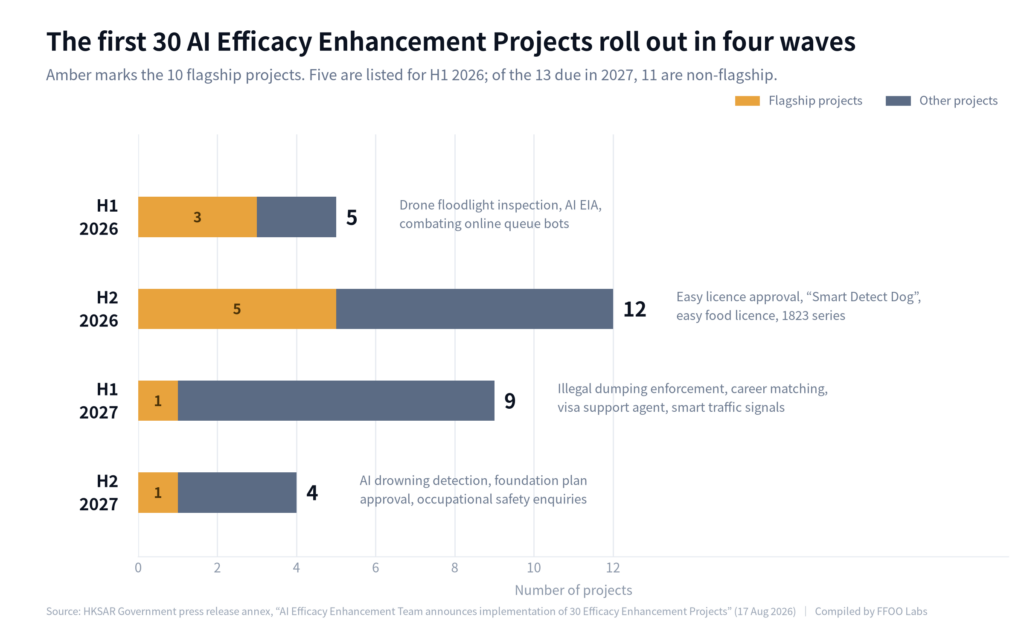
Because the announcement came on 17 August, the first half of 2026 had already passed, which makes the annex’s choice of tense worth reading closely. Its descriptions of these five projects are not uniform. For the EMSD’s AI+ Drone Inspection for Floodlights it records that AI “has substantially reduced the inspection time from 8 hours to only 1-2 hours”. For the EPD’s AI Environmental Impact Assessment it states that the efficiency and precision of the various EIA stages “have been systematically enhanced” and that the timeframe “has been reduced by half”. For the Transport Department’s work on Combating Online Queue Bots it notes that “after the implementation”, waiting time has fallen. Those three report results already achieved. For the Government Logistics Department’s Fast Company Background Check (“AI-DDsearch”) and the Digital Policy Office’s 1823 Dashboard, the annex describes what the systems can do without stating delivered outcomes. The careful reading, then, is that all five are listed in the first window, some are already producing results, and the outcomes of the others have yet to be reported — not that all five can be confirmed as fully operational.
There is nothing wrong with that pace; it is closer to reality than announcing everything as complete. But it does mean most of the published figures remain projections rather than results. The annex is careful about this: projects already in service are described with “after the implementation” and “so far”; those still to come say “expected” and “anticipated”. Projects already launched may generate early operational data during 2026, but a fuller, comparable assessment across projects will only become meaningful once they have accumulated enough running time. The Government has not committed to publishing a formal review in 2027, so it would be wrong to assume that such a public stocktake is coming.
The 90 per cent is real, but it belongs to specific steps
Pull out every step in the annex that carries a before-and-after time or an explicit percentage, sort them, and a gradient appears that received little coverage: from 90 per cent all the way down to 10 per cent.
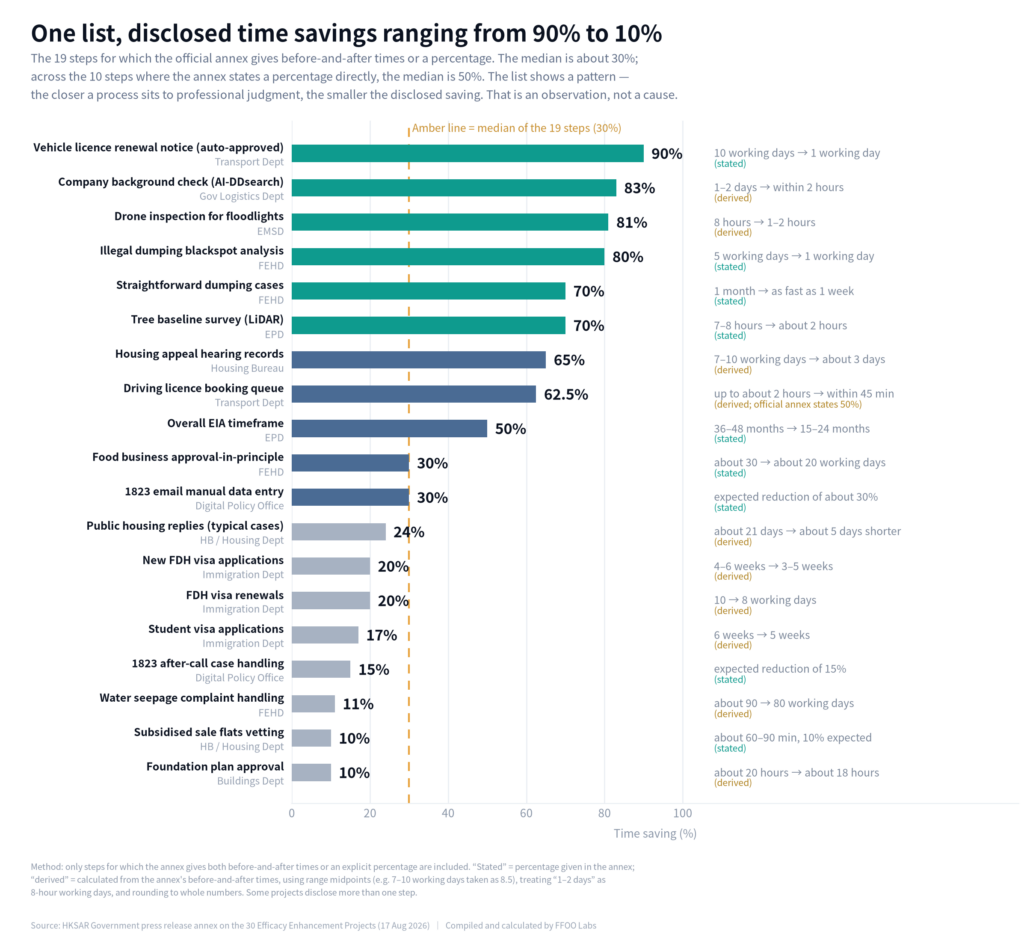
The 90 per cent belongs to the Transport Department’s Easy Licence Application Approval: for automatically approved cases, the time to issue a vehicle licence renewal notice is expected to fall from a maximum of 10 working days to 1 working day, with the automatic processing rate for online vehicle licence renewals anticipated to exceed 90 per cent. The difference in how the two documents frame the figure is worth noting. The press release says in general terms that AI can cut processing or waiting time for certain cases by 90 per cent, while the corresponding Easy Licence Application Approval project is scheduled for the second half of 2026 and described in the annex in anticipatory terms. The 90 per cent is therefore a commitment or expected outcome for one specific step, not a cross-project result already validated as of the announcement date. Processes of this kind share a profile — highly standardised formats, explicit rules, large annual volumes (the annex cites about 240,000 online vehicle licence renewal applications a year) and very little judgment. The Government Logistics Department’s company background check (one to two days down to within two hours) and the EMSD’s drone inspection for floodlights (8 hours down to 1–2 hours) have a similar structure.
The other end of the list is notably restrained. The Buildings Department’s Easy Foundation Plan Approval uses a domain-specific visual language model to check plans against the Buildings Ordinance, Codes of Practice and internal engineering manuals, and will shorten vetting and approval time for a plan from about 20 hours to about 18 — roughly a tenth. The Housing Bureau and Housing Department’s Easy Subsidised Sale Flats Application expects to cut case vetting time by 10 per cent from about 60–90 minutes. The FEHD’s overall water seepage complaint handling is expected to fall from roughly 90 working days to 80, again about a tenth. The 1823 Call Assistant is expected to reduce after-call processing time by 15 per cent.
How the median was calculated — and what it does not mean
Under the methodology used here, the median saving across the 19 quantified steps is about 30 per cent; across the 10 steps where the annex states a percentage directly, the median is 50 per cent. The method needs stating plainly. We included only steps for which the annex gives both a before and an after figure, or states a percentage outright. Ten of the percentages come straight from the annex — the 90 per cent for renewal notices, the 80 per cent for blackspot analysis, the halving of the EIA timeframe, and so on — while the other nine are derived from the times the annex provides. Where a range is given, we take the midpoint (housing appeal hearing records, for instance, move from 7–10 working days to about 3, so the “before” figure is taken as 8.5). “One to two days” is treated as 8-hour working days. Each step is measured as a relative reduction within its own unit of time, whether months, weeks, working days, hours or minutes, with no weighting across units; results are rounded to whole numbers. Where one project discloses more than one step — Swift Enforcement at Illegal Dumping Blackspots reports both blackspot analysis and straightforward cases — each step is counted separately.
The median should not be treated as a general return benchmark for AI projects, nor as the typical real-world yield of language or vision models in administrative work. The 19 cases cover different technologies, workflow stages and measures of time, and most remain expectations rather than results. It is useful mainly because it shows how widely the disclosed outcomes vary — far more widely than the headline “90 per cent faster” suggests. The most restrained entry in the annex, and for that reason one of the more informative, is the Buildings Department’s willingness to write down 20 hours becoming 18: a figure with no promotional value at all.
The more significant shift: AI is moving closer to judgment itself
From where FFOO Labs sits, the dividing line in this list is not efficiency but function. Several projects have stopped merely turning paper into data and now stand at the door of administrative judgment:
- Immigration Department, Visa Intelligent Support Agent: about 125,000 student visa and 250,000 foreign domestic helper visa applications a year. Beyond automatic completeness and consistency checks and auto-drafted approval records, the annex states that “subject to the project outcome, AI can be explored to verify the authenticity of submitted supporting documents (such as academic certificates, proof of address, etc.)”. If that exploration is eventually implemented, authenticity verification would enter the realm of substantive judgment; it is not currently a committed feature.
- Buildings Department, Easy Foundation Plan Approval: a visual language model compares plans against legislation and codes, identifies anomalies and generates a preliminary vetting report.
- FEHD, Swift Enforcement at Illegal Dumping Blackspots: AI analyses complaint content and “provide[s] enforcement recommendations”.
- Housing Bureau / Housing Department, Easy Subsidised Sale Flats Application: the next phase will “assist in determining whether applications meet eligibility according to approval criteria”, with potential extension to other application types such as public rental housing.
- Labour Department, Career Matching Hub: an average of about 800,000 job matches a year, with AI and large language models producing personalised vacancy recommendations and training advice.
- LCSD, AI Drowning Detection System: full-coverage, real-time monitoring of the pool to help lifeguards pinpoint suspected drowning cases — a safety-critical setting, with a first-phase proof of concept at two swimming pools.
Moving from clerical automation into preliminary judgment changes the level and pathway of risk. Purely clerical errors are often easier to catch in a later review, but document-extraction or cross-checking errors can still feed into licensing, eligibility or enforcement decisions. Once AI output directly affects triage, eligibility or a safety alert, the consequences can fall more directly on a specific person: an address proof wrongly flagged as inconsistent, a seepage case misrouted, a complaint recommended for enforcement, or a drowning alert that never fires.
The annex does not set out those safeguards project by project. It does not state error rates, human review ratios, where final human decision-making is preserved, whether a member of the public can learn that their case was triaged or scored by AI, or how an AI-assisted decision can be appealed. The Government does have relevant instruments elsewhere: the Digital Policy Office has issued the Ethical Artificial Intelligence Framework and the Hong Kong Generative Artificial Intelligence Technical and Application Guideline. The former provides for AI impact assessment and risk classification, and recommends a human-in-the-loop approach for high-risk applications; the latter offers practical guidance on the limitations, data-leakage risks, bias, errors and governance principles of generative AI. The Government has also explicitly stressed that humans with the appropriate professional expertise should make the final judgment in processes involving major decisions. In March 2026 the Secretary for Justice convened a Steering Committee meeting on the establishment of the Inter-Departmental Working Group to Review Legislation to Support Wider Application of AI. What is not public is how those instruments map onto these 30 specific projects. Whether the second batch is published together with its review and accountability arrangements is, to us, the question most worth pressing.
An easily missed theme: government is using AI to counter automated abuse
Two projects on the list belong squarely to the same category, though they sit in different departments. The Transport Department’s Combating Online Queue Bots targets online appointment bookings for direct issue of Hong Kong driving licences, covering about 90,000 applications a year; AI automatically analyses user behaviour such as mouse clicks and keystrokes, with a target of blocking approximately 99 per cent of bot programs. The LCSD’s work on Combating Touting of Bookings of Leisure Facilities covers about 27,000 bookings a day and identifies accounts that use bots or other automated tools. The FEHD’s use of Internet Protocol cameras to detect illegal dumping also employs anomaly detection, but it is visual enforcement support rather than a response to automated abuse.
This is a condition that gets little discussion but matters a great deal: the fairness of public resource allocation has been eroded by automated tools to the point where AI is needed to restore it. Here the Government’s role is not only to improve efficiency but to repair a queue that bots had distorted. After implementation of the Transport Department project, online booking waiting time fell from a maximum of about two hours to within 45 minutes. Calculated from 120 minutes to no more than 45 minutes, that is a reduction of at least 62.5 per cent — a direct and tangible benefit to residents.
The same mechanism creates tension, though. To recognise a bot, the system must model how real people move a mouse and press keys. To stop touting, it must build anomaly profiles of user accounts. That is behavioural monitoring, not identity verification. The annex does not say how long such behavioural data is retained, whether it may be reused for other purposes, or how someone wrongly classified as a bot can contest the outcome. Efficiency and fairness are two sides of the same coin here; privacy and explainability are its edge.
What this means in practice for Hong Kong businesses and professionals
Abstract the technical routes of the 30 projects and four patterns remain, each of which maps directly onto processes companies already run:
- Document extraction and cross-checking (AI optical character recognition plus consistency checks): the Companies Registry expects recognition accuracy on hard-copy forms to rise from about 70 per cent to 97 per cent; the Housing Bureau and Housing Department will automatically identify about 60 types of supporting documents; Immigration will check completeness and consistency automatically. The private-sector equivalents are accounts payable, customer due diligence, expense claims and pre-acquisition review.
- Knowledge base plus drafting: the Housing Bureau and Housing Department’s Reply Fast Public Correspondence System consolidates departmental guidelines, operation manuals and standard templates to auto-draft replies. The annex notes that a substantive reply is currently issued within about 21 days, and that for typical cases the average processing time is expected to be about five days shorter than under the present workflow. The equivalents are customer service replies, compliance enquiries and internal policy Q&A.
- Triage and prioritisation: 1823 receives 65,000 departmental reply emails a month, about 1,500 of which need priority handling; the existing rule-based system identifies only 1,000, and AI is expected to cut identification time from two days to within a few hours. The equivalents are ticket routing, complaint escalation and risk alerting.
- Sensing plus field intelligence: drone inspection for floodlights, LiDAR tree surveys, the EPD’s “Smart Detect Dog” “Zhiao”, and the EMSD’s AI Chiller Optimisation (“ChillStream”). The equivalents are facilities management, energy cost and asset inspection.
Patterns 2 and 3 deserve particular attention from professionals. Some projects explicitly position AI as a tool for producing drafts or recommendations, but the annex does not confirm the final-decision, human-review and exception-handling arrangements for every project. In audit, accounting and compliance work — where accountability requirements are high and the consequences of error are significant — retaining a final human decision is generally a more defensible and auditable approach: the trail is clear, responsibility is identifiable, and the work can be reviewed. For lower-risk processes governed by explicit rules, such as format checks, data transcription and standard notifications, a human decision on every single case is not necessarily warranted; sample-based review with exception handling is usually the better fit. The projected savings stated in the annex — including five days, 30 per cent and 15 per cent — are substantial, but they depend on review procedures and audit trails being built alongside the automation. The part this list leaves unwritten is exactly the part any organisation copying it must supply itself.
Three questions FFOO Labs will keep tracking
- Whether replication actually holds. Getting from 30 projects to 100 procedures in 2026 and 200 by the end of 2027 rests on portable scenario templates. If the second batch shows the same pattern reused across departments, the strategy has a good chance of working; if it is another set of bespoke builds, 200 becomes very hard.
- Whether accountability is published alongside efficiency. Once AI recommends enforcement, helps assess eligibility and potentially — in a future phase — verifies document authenticity, review ratios, error handling and appeal routes stop being technical detail and become the quality of the public service itself.
- How frontline roles change. The annex repeatedly says human resources will be “allocated more effectively to focus on complex cases that require professional judgment”. That is the best version. Whether it becomes a focus on complex cases or simply more cases per person can only be judged from operational data later on — and whether that data will be published is itself an open question.
In one line
The most valuable thing about these 30 projects is not the 90 per cent. It is that the Government was willing to put the 10 per cent in the same annex. A list that publishes the whole gradient is more useful than a summary that mentions only the peak — and the real test now is whether the same candour extends to explaining what happens when AI judgment gets it wrong.
Sources
- HKSAR Government press release, “AI Efficacy Enhancement Team announces implementation of 30 Efficacy Enhancement Projects”, with annex “Overview of First-Batch Efficacy Enhancement Projects”, 17 August 2026: https://www.info.gov.hk/gia/general/202608/17/P2026081700324.htm (Chinese version: P2026081700318; English annex PDF: download; Chinese annex PDF: download)
- HKSAR Government press release, “DPO hosted exchange session on ‘AI+’ Civil Service: Industry’s Role in Reshaping the Government’s Approach to Public Service Delivery”, 17 August 2026: https://www.info.gov.hk/gia/general/202608/17/P2026081700344.htm
- The Chief Executive’s 2025 Policy Address, announcing the establishment of the AI Efficacy Enhancement Team: https://www.policyaddress.gov.hk/2025/en/p40.html
- Innovation, Technology and Industry Bureau, written reply to a Legislative Council question setting out the target of 100 public administration procedures in 2026 and no fewer than 200 by the end of 2027: https://www.itib.gov.hk/en/legislative_council_business/questions/2026/pr_20260121.html
- Legislative Council Panel on Innovation, Technology and Industry paper CB(2)730/2026(02), “Work on promoting the development of the artificial intelligence ecosystem and ‘AI for All'”, June 2026: https://www.legco.gov.hk/yr2026/english/panels/itb/papers/itb20260608cb2-730-2-e.pdf
- Digital Policy Office, speech by the Commissioner for Digital Policy on the “AI+ Toolbox” catalogue and coverage of public administration procedures, 4 February 2026 (Chinese): https://www.digitalpolicy.gov.hk/tc/news/speeches/2026/02/sp_20260204.html. See also the Commissioner’s English speech of 27 July 2026: sp_20260727_1
- Digital Policy Office, Ethical Artificial Intelligence Framework and Hong Kong Generative Artificial Intelligence Technical and Application Guideline: https://www.digitalpolicy.gov.hk/en/our_work/data_governance/policies_standards/ethical_ai_framework/
- Digital Policy Office, speech by the Commissioner for Digital Policy on AI risk governance and human oversight in major decisions, 15 April 2026 (Chinese): https://www.digitalpolicy.gov.hk/tc/news/speeches/2026/04/sp_20260415_1.html
- Department of Justice, “SJ convenes Steering Committee meeting on establishment of Inter-Departmental Working Group to Review Legislation to Support Wider Application of AI”, 6 March 2026: https://www.doj.gov.hk/en/community_engagement/press/20260306_pr1.html
- RTHK, report on the AIEET’s first 30 projects rolling out from mid-year with some case processing times cut by 90 per cent, 17 August 2026: https://news.rthk.hk/rthk/ch/component/k2/1866445-20260817.htm