
In recent years, many employees have encountered the same contradiction: they have learned to use ChatGPT, Copilot, automated workflows, and even AI agents. Their work is genuinely faster and their output has increased, yet their salaries have barely changed.
This raises an obvious question: if AI really improves productivity, why have companies not increased pay accordingly? Does learning AI simply have no value?
The answer is not that AI has no value. It is that productivity gains, business value, and personal compensation are three related things that do not connect automatically.
A study published in The Quarterly Journal of Economics tracked 5,172 customer-support agents and found that access to a generative AI assistant increased the number of issues resolved per hour by an average of 15%. However, the researchers also made clear that they observed no change in employee pay, overall labor demand, or hiring patterns. In other words, the study showed that AI could improve work efficiency, but not that these gains would automatically become individual pay raises. Original study
This is the reality many employees face: you may create more value, but the company may not see it. Even if it does, you may not have the power to claim a share of that value.
The Market Says AI Is Valuable—So Why Haven’t You Received a Raise?
First, consider a seemingly contradictory set of figures.
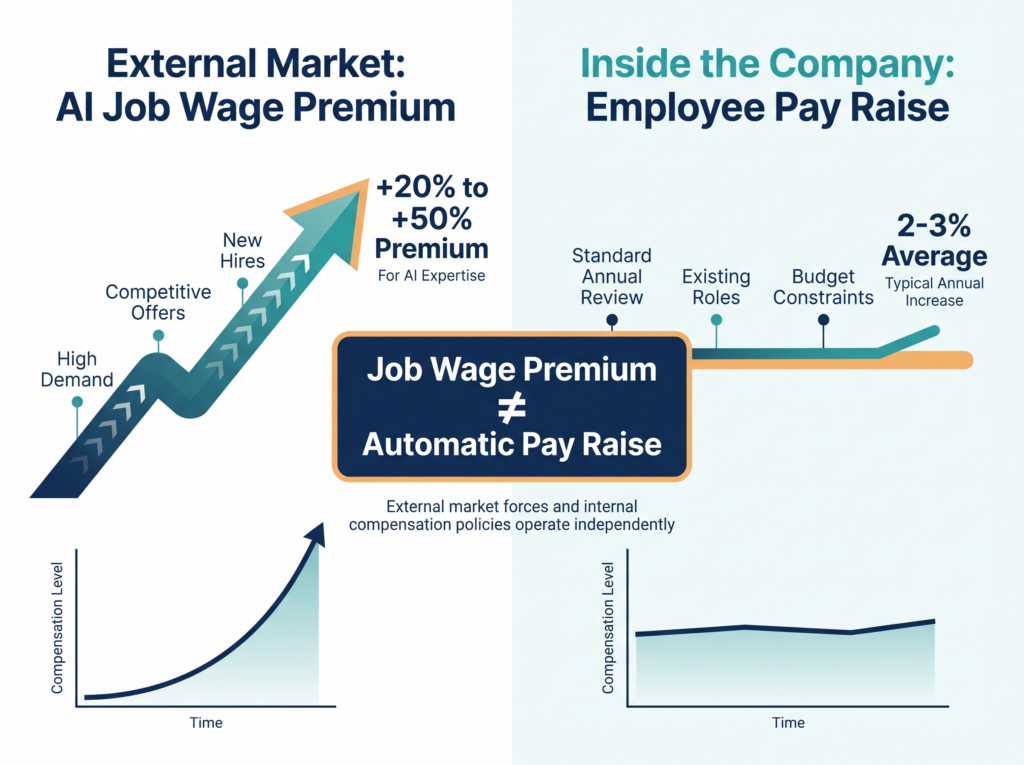
PwC’s 2025 Global AI Jobs Barometer, based on an analysis of nearly one billion job advertisements and corporate records, found that roles requiring AI skills offered an average wage premium of 56% over comparable roles that did not require them. In Hong Kong, the share of job advertisements requiring AI skills also rose from 1.6% to 1.9%. PwC Hong Kong report
By 2026, PwC’s Hong Kong data showed that AI-related job postings had increased by 50% from 2024 to 2025, while their share of all job advertisements had risen from 3.6% to 4.7%. This suggests that employer demand for AI capabilities is still growing. PwC 2026 Hong Kong data
But these figures should not be interpreted to mean: “Once I learn AI, my current employer should give me a 56% raise.”
There are three reasons:
- A job-market premium is not the same as an internal pay raise. Job-advertisement data compares the market prices of different roles or candidates; it does not compare one employee’s pay before and after learning AI.
- Correlation is not causation. Roles requiring AI skills may also demand deeper professional expertise, management responsibility, data capabilities, or industry experience. Their higher pay may not be caused by AI skills alone.
- The market pays for scarce combinations, not every tool user. “Knowing how to use ChatGPT” does not have the same market value as “using AI to improve risk management, product revenue, or customer experience.”
There is therefore no contradiction between macroeconomic data showing a premium for AI talent and an individual employee receiving no immediate raise after learning AI.
Two Invisible Barriers: Your Company Does Not Know You Use AI—and You May Be Afraid to Say So
The analysis above assumes that a company knows how its employees use AI and can recognize the value AI creates.
Reality may be very different.
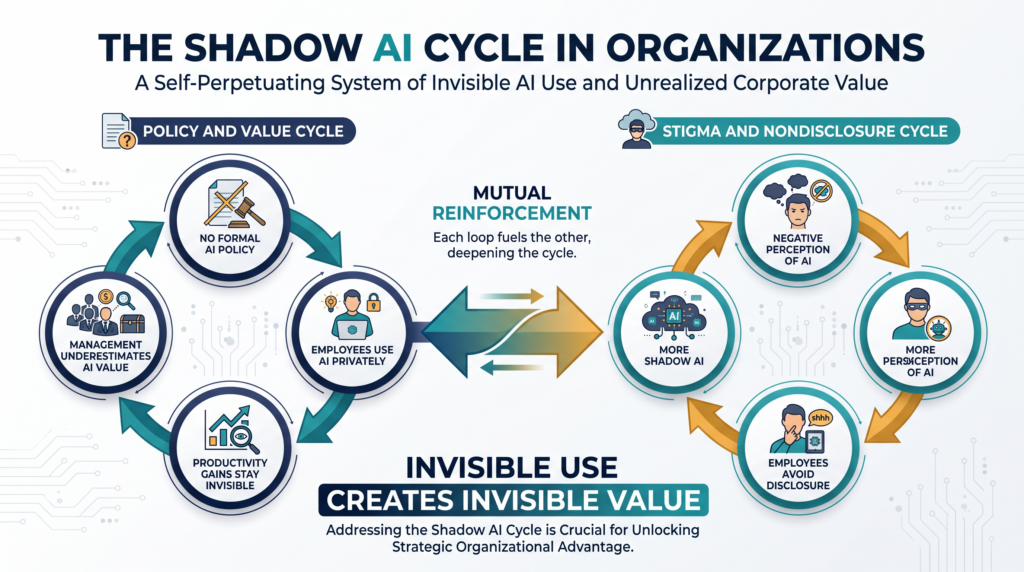
In many companies, AI is not formally introduced by management. Employees simply begin using it themselves. Some use ChatGPT to organize information, some use Copilot to revise documents, and others build their own automated workflows. If the company provides no approved tools, training, usage guidelines, or performance metrics, employees may quietly incorporate AI into their personal working methods.
Employees become more efficient, but the improvement may never enter the company’s formal records.
Barrier One: The Value Created by AI Is Invisible
A 2025 McKinsey survey found that executives estimated only 4% of employees were using generative AI for at least 30% of their daily work. In reality, 13% of employees said they had reached that level. Actual employee adoption was more than three times higher than leaders estimated. McKinsey research
This employee-led use of AI outside formal management and IT systems is sometimes called “shadow AI.”
It creates a workplace paradox:
- Employees use AI to improve efficiency
- The company benefits from faster output
- Management does not know where the improvement came from
- Employees cannot prove that they designed the solution
- The company cannot turn individual experience into a formal process
Under these conditions, the value created by AI may be invisible to both the company and the employee.
The company merely sees work completed on time and may not realize that the underlying method has changed. The employee, meanwhile, lacks baseline data and an official project mandate, making it difficult to prove their contribution during a performance review or salary negotiation.
This can be understood through the management concept of “absorptive capacity.” A company’s exposure to a new technology does not mean it can automatically recognize, absorb, and exploit it. It still needs management support, employee training, knowledge sharing, formal processes, and suitable performance metrics to turn an individual’s new method into an organizational capability.
The problem, therefore, may not simply be that “the boss does not understand AI.” The company may have no system for recognizing AI’s value in the first place.
Barrier Two: Admitting You Use AI May Damage Your Professional Image
Even if employees are willing to discuss how they use AI, they may face another problem: AI is often associated with errors, hallucinations, laziness, and a lack of originality.
A 2025 study published in the Proceedings of the National Academy of Sciences conducted four experiments involving more than 4,400 participants. It found that people who used AI to help with their work could be judged by observers as lazier, less competent, and less diligent. PNAS study
In other words, even when AI improves a person’s performance, the label “AI user” may itself carry a social penalty.
This also relates to the psychological concept of “algorithm aversion.” Earlier research found that even when an algorithm performs better overall than humans, people may quickly lose confidence after seeing it make a mistake and instead choose inferior human judgment.
People often tolerate human and AI errors differently:
- If a colleague occasionally writes something incorrectly, it may be treated as an ordinary oversight
- If AI generates one incorrect statement, people may question whether the entire tool is reliable
- When a person makes a mistake, others consider their experience, motivation, and working environment
- When AI makes a mistake, people are more likely to attribute the problem to the technology itself
Employees may therefore face a dilemma: if they do not disclose their AI use, management cannot see their capability; if they do disclose it, others may assume that the work lacked thought or verification.
The Question Is Not Whether to Disclose, but How to Explain
The solution should not be to conceal AI use. When work involves customer information, personal data, financial data, professional judgment, or important decisions, using an external AI tool without approval may create privacy, confidentiality, and compliance risks.
In its 2025 guidance on employee use of generative AI, Hong Kong’s Office of the Privacy Commissioner for Personal Data also recommended that organizations clearly specify approved tools, permitted uses, restrictions on data input, verification procedures, training, and the consequences of non-compliance. Privacy Commissioner’s guidance
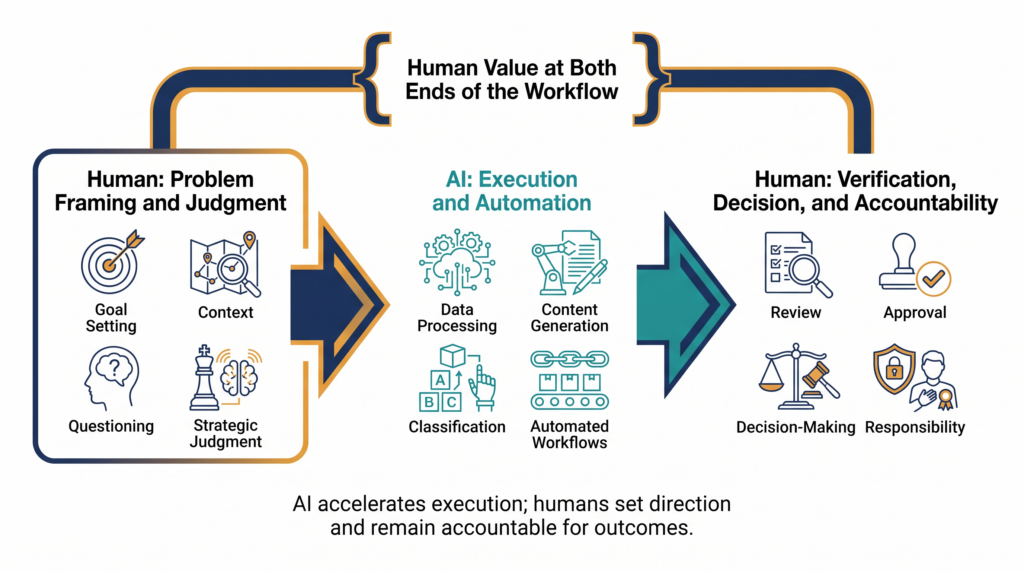
What employees really need to learn is how to explain precisely which parts were handled by AI and which parts remained their responsibility.
For example, do not simply say:
I used AI to produce this report.
That statement may sound as though the work was delegated to AI and could raise doubts about whether the content was checked.
Instead, say:
I used a company-approved AI tool to assist with organizing and conducting a preliminary analysis of the data. I independently verified the source data, key assumptions, cited sources, and final conclusions. This workflow reduced processing time from six hours to two while preserving human review and accountability.
The second version makes four things clear:
- What AI did
- What the person did
- How errors were controlled
- What outcome improved
The valuable capability is not merely operating AI. It is designing a reliable human–AI workflow, knowing what can be delegated to AI and what requires human judgment, and accepting responsibility for the final result.
The First Key: Companies Buy Results, Not Your Effort
Traditional human-capital theory treats education, training, and work experience as investments in oneself. Economist Gary Becker argued that investment in human capital can generate returns through higher productivity and income. NBER: Human Capital
The theory is not wrong, but in the real workplace it omits two intermediate steps: your new capability must be visible and measurable, and it must be shown to affect business outcomes.
Suppose Ming originally spent ten hours a week preparing reports. After learning to use AI, he needs only three. On the surface, his efficiency has improved. But the company could interpret this in three ways:
- Ming has saved the company seven hours and can now handle more high-value work
- The task never really required ten hours; the previous method was simply too slow
- Anyone using the same tool could achieve the same result, so the capability is not unique to Ming
Only the first interpretation strongly supports a pay raise. To persuade management to adopt it, Ming cannot merely say, “I can do it faster now.” He must show where the saved time went, how much output increased, whether the error rate fell, whether revenue or customer satisfaction improved, and how the results came from a process he designed.
“How much AI I have learned” is therefore weak evidence for a raise. “Which business outcomes I changed with AI” is much stronger.
The Second Key: Are You Strengthening Yourself—or Training the Company to Replace You?
Economists Daron Acemoglu and Pascual Restrepo offer a useful way to understand this through their task-based framework. Rather than treating a job as an indivisible whole, they divide it into different tasks: some are performed by people, while others can be assigned to machines or algorithms.
When technology takes over tasks previously performed by people, it creates a “displacement effect.” When new technology creates new work, responsibilities, and demands for judgment, it produces a “reinstatement effect” through new tasks. The former may reduce demand for labor, while the latter can increase the value of human contribution again. American Economic Association
Subsequent research by Acemoglu and Restrepo estimated that 50% to 70% of the changes in the US wage structure across worker groups between 1980 and 2016 were associated with task displacement caused by automation. Oxford Academic
In simple terms:
- If you merely use AI to complete an easily standardized task faster, the company may eventually document the method and assign it to more people—or automate it entirely
- If you use AI to identify new problems, build new services, improve decisions, and assume responsibility for outcomes, you are not merely accelerating an old task; you are creating new value for your role
For example, using AI to summarize meeting notes mainly improves execution efficiency. Using AI to analyze a large volume of customer feedback, identify the causes of churn, design a retention program, and track the results involves problem definition, business judgment, cross-functional coordination, and accountability. Both involve AI, but the latter is harder to replace completely with a tool or standardized process.
The Third Key: Useful Does Not Mean Rare
Skill-biased technological change theory argues that new technologies often increase demand for certain highly skilled workers, producing higher returns for people whose capabilities complement the technology. The problem is that when a skill spreads rapidly, it also becomes less scarce.
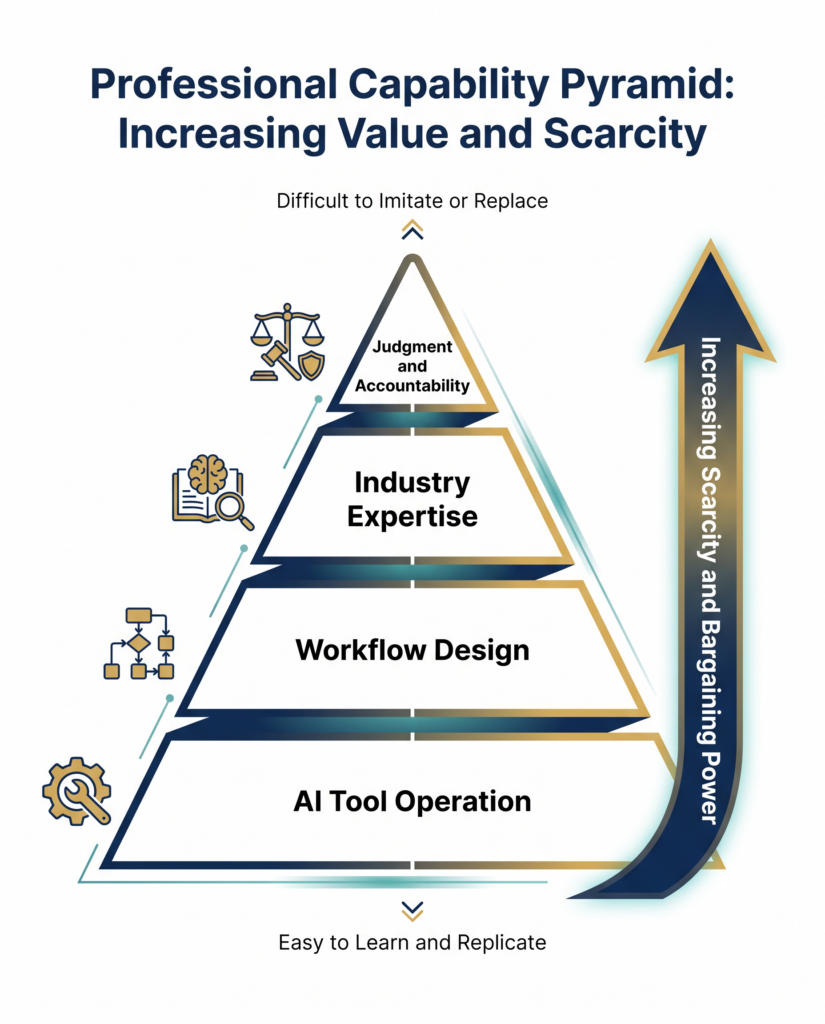
A few years ago, knowing how to write basic prompts or build a simple automated workflow might have made someone stand out. These capabilities remain useful today, but many more people can now acquire them. As supply increases, “knowing the tool” becomes less able to sustain a long-term compensation advantage.
This can be understood using the resource-based view of strategy and the VRIO framework. Jay Barney’s theory argues that, to generate sustained competitive advantage, a resource must be valuable, rare, difficult to imitate, and effectively organized for use. Barney’s original paper
Applied to an individual, this produces four questions:
| Question | Basic AI tool skills | High-value AI capability combination |
|---|---|---|
| Is it valuable? | Saves time | Directly improves revenue, cost, risk, or customer outcomes |
| Is it rare? | Many people can learn it quickly | Combines domain knowledge, data literacy, and practical experience |
| Is it difficult to imitate? | Prompts and workflows are easy to copy | Judgment, professional networks, case experience, and a track record of accountability are difficult to copy |
| Can the organization use it? | Remains a personal productivity gain | Can be embedded in team processes, governance systems, and measurable indicators |
What usually commands a premium is not the word “AI,” but combinations such as:
- AI + accounting, law, medicine, engineering, or other domain expertise
- AI + customer insight and business judgment
- AI + data governance, risk control, and compliance
- AI + process design and cross-functional implementation
- AI + the authority and track record to take responsibility for outcomes
Tools become widespread, but deep contextual knowledge, trustworthy judgment, and the ability to assume responsibility do not become commodities at the same speed.
The Fourth Key: Creating Value and Capturing Value Are Different Things
Even when you create measurable results, the company will not necessarily convert part of those results into your compensation voluntarily.
This can be understood through Nash bargaining. In labor economics, wages are not determined by productivity alone; they also depend on how employers and employees divide the additional value created by working together. Modern labor-market models frequently use Nash bargaining to analyze wages, with key factors including employee productivity, competition among employers for talent, and the employee’s bargaining power. ECB working paper
Imagine that your use of AI saves the company $500,000 a year. That $500,000 is newly created value available for distribution, but it does not mean you automatically receive a particular percentage. The actual result depends on:
- Whether the company believes that you led the improvement rather than the tool producing it automatically
- Whether your capabilities can easily be replaced by another employee or an outsourced service
- How much it would cost the company to rebuild the capability if you left
- Whether you have credible opportunities in the external job market
- Whether the company has promotion, bonus, or grade-adjustment mechanisms for sharing gains
- Whether you formally request an adjustment to compensation or responsibilities that matches the evidence
This is why two employees with similar AI skills can have completely different compensation outcomes. One simply completes work faster. The other keeps records of results, builds cross-functional influence, gains external market recognition, and presents a concrete proposal at the right time. The second employee has stronger outside options and a better bargaining position, making it easier to capture a share of the value they created.
Bargaining does not mean threatening to resign. It means ensuring that both sides clearly understand what your work creates, how costly you are to replace, and what continued cooperation could deliver.
Turning AI Skills Into Leverage for a Pay Raise
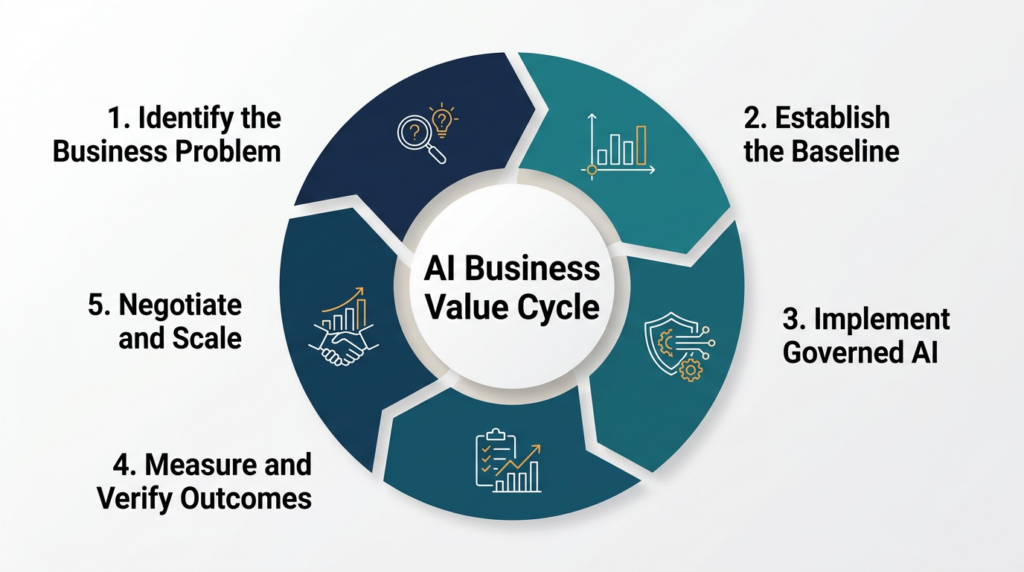
If you want to move beyond simply “learning many tools,” use the following five-step approach.
1. Move From a Tool List to a Business Problem
Do not start with “I want to use this AI tool.” Start with “Which of the company’s current problems is the most expensive?”
Prioritize problems related to metrics such as:
- Revenue: conversion rate, renewal rate, customer churn, average order value
- Cost: processing time, staffing requirements, outsourcing expense, rework costs
- Risk: error rates, complaints, compliance incidents, omissions, and delays
- Speed: delivery cycle, response time, decision time, product launch time
- Quality: accuracy, customer satisfaction, first-time completion rate
2. Establish a Baseline
Without a “before” figure, it is difficult to prove the “after” improvement.
Before introducing AI, record the original labor hours, cost, throughput, error rate, and quality indicators. Do not rely on one successful case. Where possible, observe performance over several weeks or months so that short-term fluctuations are not mistaken for lasting results.
3. Reinvest the Time Saved
Simply saving time may only prompt management to assign you more work. A more valuable approach is to redirect the saved time proactively toward higher-value tasks such as customer communication, risk review, process improvement, product design, or team training.
The key question is not “I worked seven fewer hours,” but “What new outcomes did I create with those seven hours?”
4. Build Credible Evidence That Is Difficult to Replicate
Maintain a simple AI results log containing the following:
| Item | What to record |
|---|---|
| Original problem | The original process’s time, cost, risks, or limitations |
| Your role | How you defined the problem, designed the solution, and coordinated stakeholders |
| AI’s role | Which steps AI assisted with and which still required human judgment |
| Improved outcome | Changes in labor hours, cost, revenue, quality, or risk |
| Verification method | Data sources, comparison periods, and possible limitations |
| Governance arrangements | Whether the company approved the tool and whether any sensitive, personal, or confidential data was entered |
| Review process | Who checked the data, citations, calculations, assumptions, and final conclusions |
| Sustainability | Whether the workflow is repeatable, scalable, and compliant with governance requirements |
This record supports salary negotiations and can also become the basis of your résumé, portfolio, and interview case studies.
5. Propose an Exchange, Not Just a Demand
Instead of saying, “I have learned a lot about AI, so I would like a raise,” present a proposal that connects results, governance, and future responsibilities:
Over the past six months, I used a company-approved AI tool to redesign a particular process. The average processing time per case fell from 45 minutes to 20 minutes, while the error rate dropped from 6% to 2%. AI handled initial organization and classification, while staff reviewed all material information and final outputs. Based on current volume, this workflow could save approximately a specified number of labor hours or a specified amount of cost each year. For the next stage, I propose expanding it to two additional teams, with me taking responsibility for performance metrics, staff training, access management, and risk control. I would also like to discuss how my role, grade, and compensation should reflect these additional responsibilities.
This framing brings together past results, risk controls, future value, additional responsibility, and compensation in one business case. It is usually more persuasive than listing completed courses or the number of tools you know.
Three Common Situations
Situation One: Work Is Faster, but There Is No Visible Outcome
You do not need to learn another tool. You need a baseline and outcome metrics. Connect “how much faster” to throughput, cost, quality, or customer results, and make sure management understands how the improvement was produced.
Situation Two: The Results Are Clear, but the Company’s System Does Not Reward Them
If the grading structure, salary bands, or management culture provides no mechanism for sharing productivity gains, becoming even more efficient may not improve your return. Explore internal transfers, promotion, project bonuses, or external market opportunities rather than assuming that more effort will eventually be recognized.
Situation Three: AI Skills Have Become Ordinary
Stop competing over how many tools you know. Instead, build a combination of “AI + domain expertise + business results + governance capability + accountability.” Tool skills get you through the door; a difficult-to-imitate combination raises your market value.
AI Is Not an Automatic Pay-Raise Machine
AI can improve productivity, but higher pay requires at least six conditions to exist at the same time:
- Your AI application solves a genuinely valuable business problem.
- The results are measurable and can reasonably be attributed to your judgment and work.
- Management understands how AI improved the work instead of treating the outcome as something that happened by itself.
- Your AI use complies with the company’s data, privacy, confidentiality, and risk requirements.
- Your combination of capabilities has some scarcity and replacement cost.
- You have enough bargaining power and actively propose an appropriate role-and-reward arrangement.
These six conditions can be expressed as the following model:
AI skills × business outcomes × outcome visibility × governance credibility × skill scarcity × bargaining power → compensation return
Multiplication is used rather than addition because if any one factor approaches zero, AI skills may fail to translate into actual compensation.
The question truly worth asking, therefore, is no longer: “How many more AI tools should I learn?”
It is:
What difficult-to-replace value have I created with AI? Can the company see and trust these results? Do I have enough evidence and bargaining power to obtain a fair share of that value?
Learning AI only makes you more capable of creating value. Whether the company can see that value, whether you can prove you created it, and whether both sides have the systems and willingness to distribute the gains fairly will determine whether AI ultimately becomes a pay raise, more work, or an invisible contribution no one knows about.